Commercial spray foam insulation solutions meet modern energy codes by serving as a dual-purpose solution that provides high-performance insulation and a certified air barrier. Unlike traditional fiberglass or rigid board systems, which require separate air-sealing materials and labor, spray foam expands to fill cavities, cracks, and complex framing geometries. This seamless application allows builders to achieve the continuous insulation and air-tightness requirements mandated by standards such as the International Energy Conservation Code (IECC) and ASHRAE 90.1 in a single pass.
Commercial building standards have shifted focus from simple R-value targets to strict performance metrics regarding air leakage and thermal bridging. Meeting these requirements with older insulation methods often involves labor-intensive detailing that is prone to failure during blower door testing. With extensive experience retrofitting and insulating commercial structures, Stellrr Insulation & Spray Foam recognizes that spray foam offers the most direct path to compliance by eliminating the gaps and seams that cause inspections to fail.
The Shift from R-Value to Air Tightness
Historically, commercial energy codes focused primarily on the R-value, which measures resistance to heat flow. If a wall cavity had a specific thickness of insulation, it passed inspection. Modern codes take a more holistic view of building performance. They recognize that a high R-value is ineffective if air leaks freely through the building envelope.
The IECC and ASHRAE 90.1 now emphasize the building envelope’s ability to stop air movement. Uncontrolled air leakage forces HVAC systems to work harder, increasing operational costs. A study by the National Institute of Standards and Technology (NIST) confirmed that reducing air leakage in commercial buildings can decrease gas energy consumption by over 40% and electrical consumption by more than 25%. Spray foam addresses this by expanding 30 to 120 times its liquid volume, adhering directly to substrates and sealing the air leaks that board stock or batt insulation misses.
Bonus Tip: When planning a commercial project, review the specific “Air Barrier Strategy” section of your local code amendments. Some jurisdictions require visual inspections of the air barrier before drywall installation, where spray foam makes verification easy for inspectors.
Addressing Thermal Bridging in Steel Framing
Commercial construction frequently utilizes steel studs. While durable, steel is highly conductive, rapidly transferring heat and bypassing the insulation between the studs. This phenomenon is known as thermal bridging.
Standard batt insulation placed between steel studs leaves the metal exposed or creates gaps where the batting pulls away from the framing. This significantly reduces the effective R-value of the wall assembly. Continuous insulation is the code-mandated solution to this problem.
Spray foam insulates between the studs and bonds to the steel itself. In many applications, a layer of continuous insulation is applied over the exterior. Still, spray foam is used in the cavity, preventing the convective loops (air movement within the wall) that degrade the performance of other insulation types.
Comparing Insulation Methods for Code Compliance
Selecting the right material determines how easily a project passes inspection. The table below compares common commercial insulation materials against key code requirements.
Table 1: Commercial Insulation Performance Comparison
| Insulation Type | R-Value Per Inch | Acts as an Air Barrier? | Water Vapor Control | Code Compliance Difficulty |
|---|---|---|---|---|
| Closed-Cell Spray Foam | R-6.0 – R-7.0 | Yes (at 1-2 inches) | Class II Vapor Retarder | Low |
| Open-Cell Spray Foam | R-3.5 – R-4.0 | Yes (at 3-4 inches) | Vapor Permeable | Moderate |
| Fiberglass Batt | R-3.1 – R-4.3 | No | Permeable (Requires a separate barrier) | High |
| Rigid Foam Board | R-4.0 – R-6.5 | No (unless taped/sealed perfectly) | Varies by facing | Moderate |
Managing Moisture and Vapor Drives
Modern codes integrate moisture management with energy efficiency. A tight building must manage water vapor to prevent mold and structural damage. The interaction between insulation and moisture control is a common failure point in commercial designs.
Closed-cell spray foam functions as a Class II vapor retarder. This means it prevents warm, humid interior air from reaching cold surfaces within the wall during winter, and vice versa in summer. By combining insulation solutions, an air barrier, and a vapor retarder into a single product, designers eliminate the risk of misaligned barrier layers.
According to the Spray Polyurethane Foam Alliance (SPFA), closed-cell foam’s ability to reject bulk water also makes it ideal for below-grade applications and flood-resistant construction, meeting FEMA requirements for flood-damage-resistant materials.
Things to Consider Before Making a Decision
Before specifying spray foam for a commercial project, evaluate the fire safety requirements of the building assembly. Codes strictly regulate foam plastics.
Thermal and Ignition Barriers Most commercial applications require spray foam to be covered by a 15-minute thermal barrier, such as half-inch gypsum board. In unoccupied spaces such as attics or crawlspaces, an ignition barrier (often an intumescent coating) may be sufficient. Verify the specific assembly rating required by the local fire marshal U.S. Department of Energy.
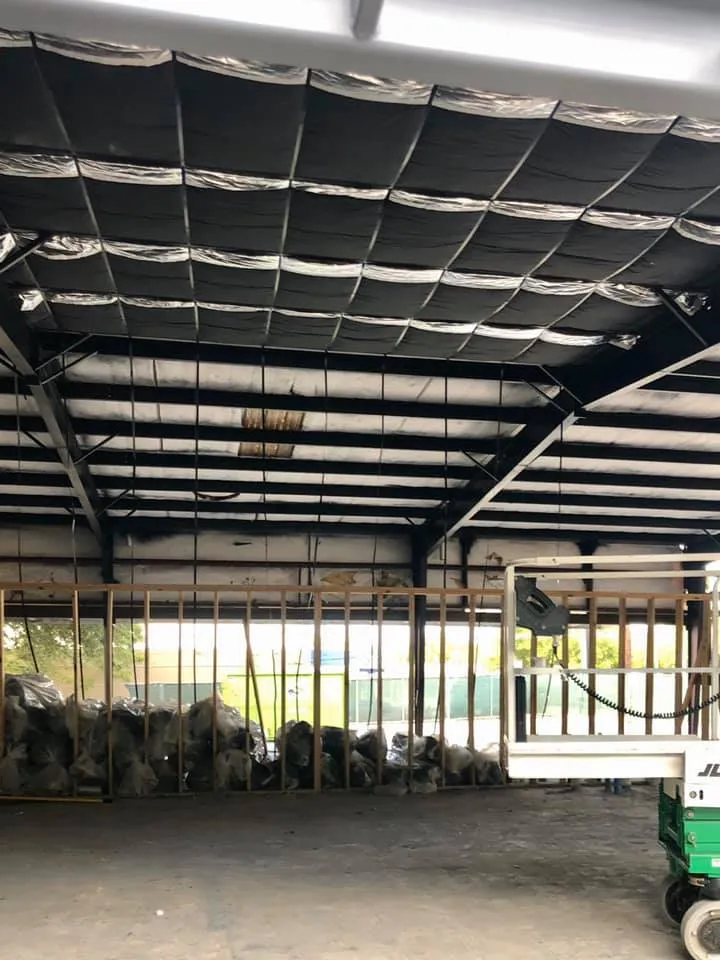
Roof Deck Applications Applying spray foam directly to the underside of a roof deck is a standard method to create an unvented attic assembly. This brings mechanical equipment inside the conditioned space, a significant plus for energy scores. However, you must ensure the roof material (shingles or metal) is compatible with the temperature rise that occurs when the attic is no longer vented.
Project Timeline Spray foam application is faster than cutting and fitting board insulation. Still, it requires the area to be vacant of other trades due to off-gassing during the curing process. Scheduling must account for this brief isolation period.
Bonus Tip: Request a “long-term thermal resistance” (LTTR) data sheet for the specific foam product. This provides the most accurate R-value rating for aging foam, which code officials may request for verification.
Conclusion
Meeting modern commercial energy codes requires a strategy that goes beyond simple thickness measurements. The focus on air sealing, thermal bridging, and moisture control makes spray foam a logical choice for builders aiming to pass strict inspections efficiently. By unifying the air barrier, insulation, and often the vapor retarder into a single application, projects reduce the complexity of the building envelope.
Builders and facility managers should assess their specific climate zone and building type to determine if open or closed-cell foam offers the best return on investment. The initial cost often offsets the labor of multi-step systems and the long-term operational savings of a truly airtight structure.
Commercial Insulation Services
Stellrr Insulation & Spray Foam provides specialized support for commercial projects aimed at strict code compliance and energy reduction.
Phone: (512) 710-2839
Email: info@stellrr.com
FAQ: Spray Foam and Energy Codes
What is the difference between open-cell and closed-cell for code compliance?
Closed-cell foam has a higher R-value per inch and acts as a vapor retarder, making it better for 2×4 walls or humid climates. Open-cell foam is less expensive and a good air barrier, but has a lower R-value per inch and allows vapor to pass through, often requiring a separate vapor-retarder paint.
Can spray foam be applied to existing commercial buildings?
Yes. It is frequently used in retrofits for metal warehouses and office buildings. It can be applied to existing substrates that are clean and dry, improving the building’s energy class without structural changes.
Does spray foam degrade over time?
Spray polyurethane foam is chemically inert once cured. It does not settle, shrink, or sag like fibrous insulation. As long as it is protected from direct UV sunlight, it maintains its performance properties for the life of the building.
Is an intumescent coating always required?
Not always. If the foam is covered by drywall or masonry, no coating is needed. Coatings are typically required when the foam is left exposed in areas like mechanical rooms, plenums, or attics to meet flame spread and smoke development ratings.
Sources
- NIST Publications – Investigation of the Impact of Commercial Building Envelope Airtightness on HVAC Energy Use.
- Spray Polyurethane Foam Alliance – Technical resources and guidance on spray foam application and code compliance.
- U.S. Department of Energy – Data regarding commercial building energy consumption and efficiency targets.