Austin’s extreme summer heat and humidity make selection in commercial new construction insulation a decision with long-term consequences for energy costs, occupant comfort, and building durability. The city sits in IECC Climate Zone 2A, classified as hot-humid, where summer highs reach 90°F or above on 123 days per year and 100°F on 29 days, with an average relative humidity around 67% according to Wikipedia’s Austin climate data. In this environment, insulation is not just about keeping conditioned air inside. It is about blocking radiant heat gain, managing moisture, and reducing the cooling load that dominates Austin’s commercial energy budgets for most of the year. The right insulation strategy depends on building type, occupancy, orientation, budget, and whether the goal is minimum code compliance or high-performance construction that exceeds it.
TLDR: Key Takeaways
- Austin falls within IECC Climate Zone 2A (hot-humid), where cooling loads drive the majority of commercial energy use year-round.
- Minimum code compliance under the 2021 IECC with local amendments is a starting point, but many developers pursue higher performance targets to reduce long-term operating costs.
- Closed-cell spray foam, rigid foam board, and reflective radiant barriers each serve different functions in Austin’s climate, from air sealing to radiant heat rejection.
- Radiant barriers can lower cooling costs by 5% to 10% in warm, sunny climates, according to the U.S. Department of Energy.
- Moisture management is as important as thermal performance in a hot-humid climate, making vapor-permeable assemblies and proper air barriers essential.
- The DOE’s Building America program recommends R-13 cavity insulation with R-5 continuous insulation for walls and R-30 for ceilings in hot-humid zones as targets for high-performance construction.
- Air tightness (ACH50 of 2.5 or lower) works hand in hand with insulation to prevent unconditioned humid air from infiltrating the building envelope.
- Insulation choices made during design affect HVAC sizing, which can lead to smaller, less expensive mechanical systems when the envelope is well-designed.
Why Austin’s Climate Demands a Different Approach
Austin experiences long, very hot summers, short mild winters, and highly variable humidity driven by shifting wind patterns between dry air from West Texas and moist air from the Gulf of Mexico. This combination means commercial buildings face two simultaneous challenges: blocking intense solar radiation and managing moisture that can accumulate within wall and roof assemblies.
In colder climates, insulation’s primary job is retaining indoor heat. In Austin, TX, the equation flips. The building envelope must resist conductive and radiant heat flowing inward during the summer while still allowing the building to retain conditioned air. The DOE’s Building America Solution Center classifies this region as hot-humid (2A) and provides specific building assemblies designed for these conditions. The recommended assemblies emphasize unvented attics with spray foam at the roof deck, continuous exterior rigid insulation on walls, and careful attention to air barrier continuity, all of which address Austin’s particular combination of heat and moisture.
Commercial buildings in Austin also operate under the locally adopted 2021 IECC with amendments, which exceeds the base international code in several areas. The Austin Energy Green Building program adds further requirements depending on project scope and size. Missing these targets during design means expensive change orders, delayed permitting, and a building that underperforms from day one.
Insulation Types and How They Perform in Austin’s Heat
Not all insulation materials behave the same way in a hot-humid climate. The table below compares the most common options used in Austin-area commercial new construction.
| Insulation Type | How It Works | Best Application in Austin | Moisture Performance | Air Sealing |
|---|---|---|---|---|
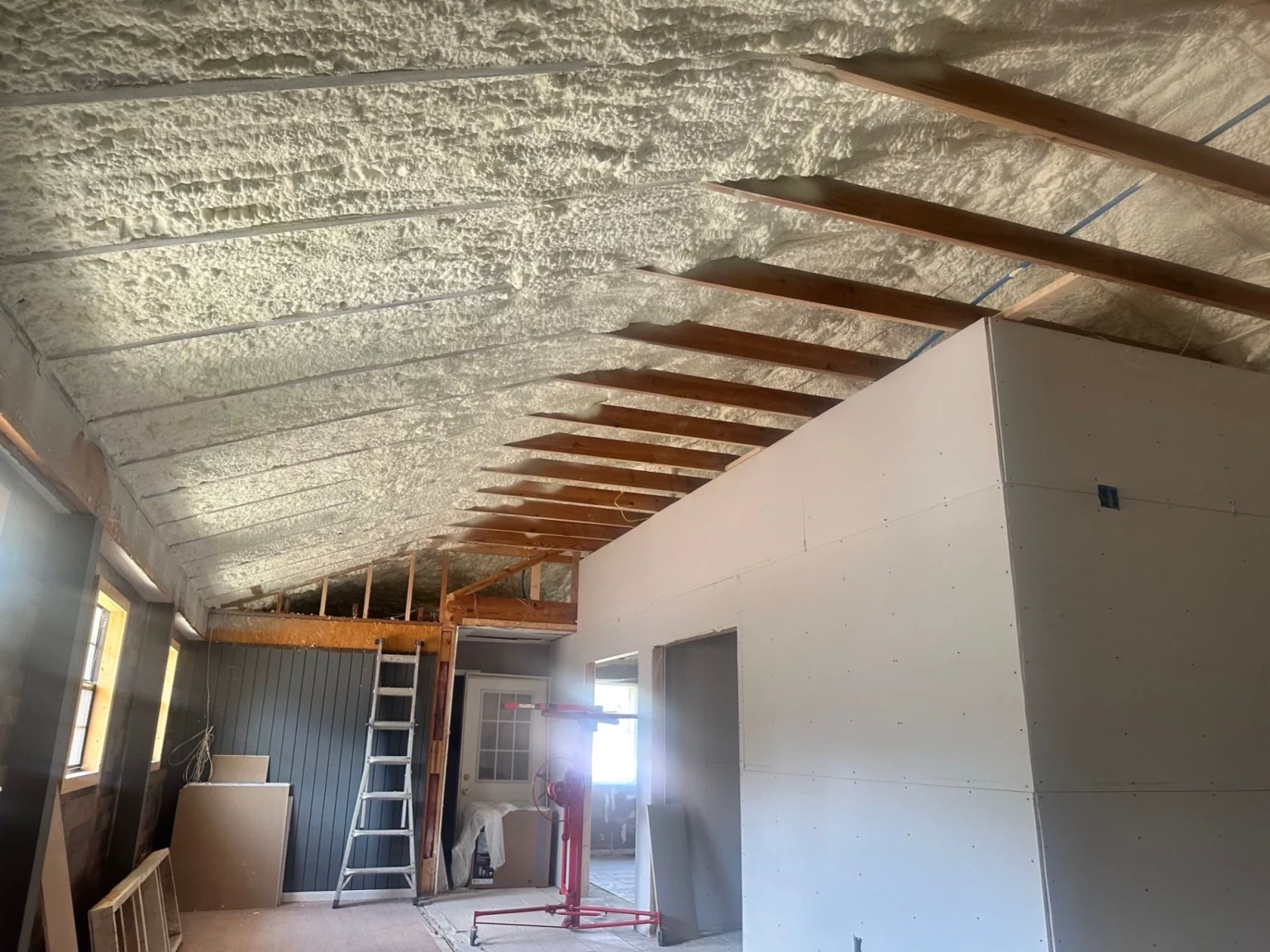
| Closed-cell spray foam | Expands to fill cavities, high R-value per inch, acts as vapor barrier | Roof decks, unvented attics, CMU walls, irregular cavities | Excellent, resists moisture infiltration | Yes, forms air barrier |
| Open-cell spray foam | Lower density, lower R-value per inch, vapor permeable | Interior wall cavities, sound control in offices | Permeable, allows drying | Yes, forms air barrier |
| Rigid foam board (polyiso, XPS, EPS) | Continuous insulation, reduces thermal bridging | Exterior wall sheathing, roof insulation above deck | Varies by type; polyiso has foil facing | No, requires separate air barrier |
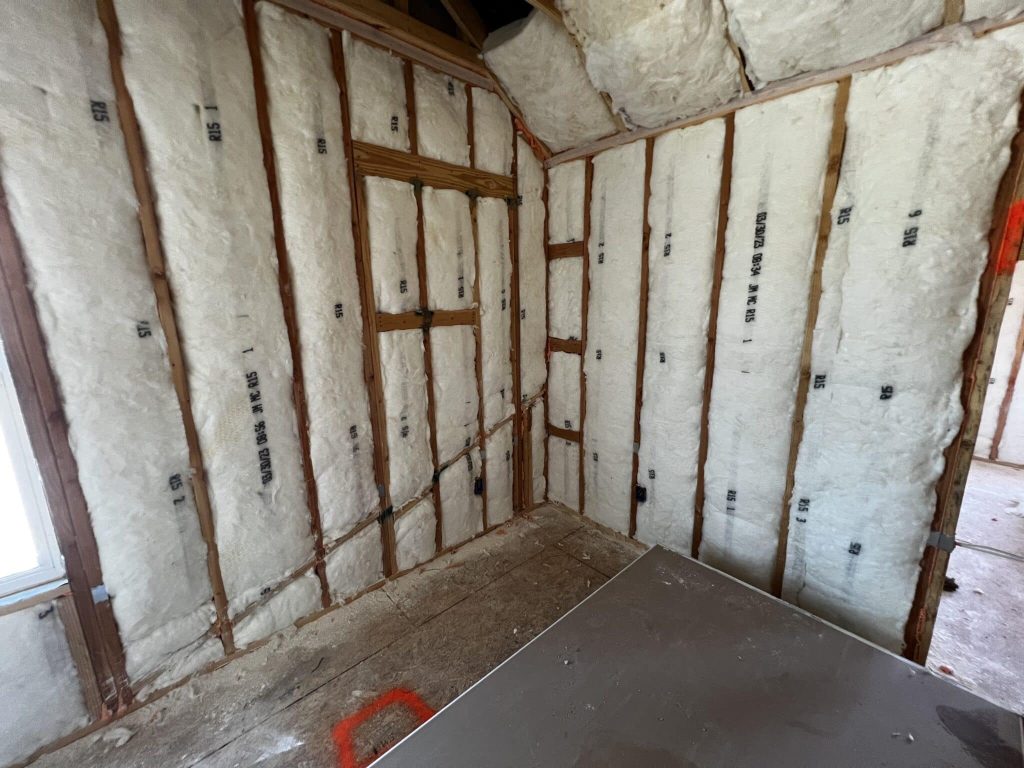
| Fiberglass batts | Standard cavity insulation, cost-effective | Interior wall studs, soffits in vented attics | Poor moisture resistance | No |
| Mineral wool batts | Fire-resistant, higher density than fiberglass | Interior walls where fire rating is required | Better than fiberglass, still absorbs water | No |
| Radiant barrier / reflective | Reflects radiant heat, not an R-value insulator | Attics, roof assemblies, metal buildings | Does not trap moisture | No |
Closed-Cell Spray Foam: The Air Sealing Workhorse
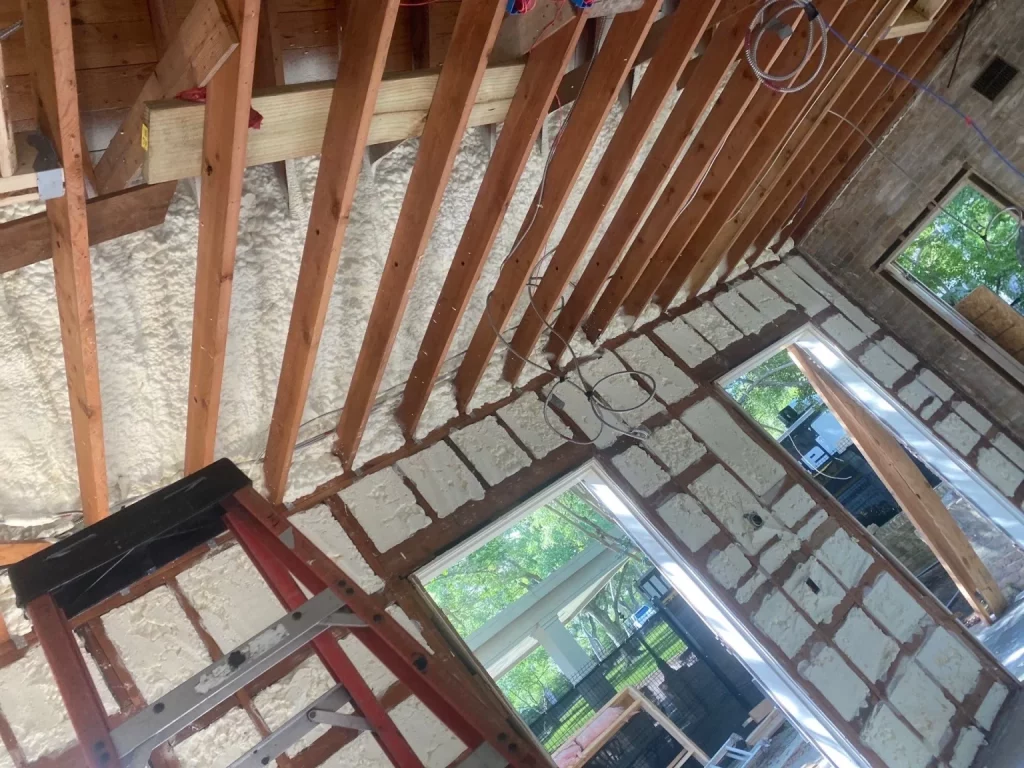
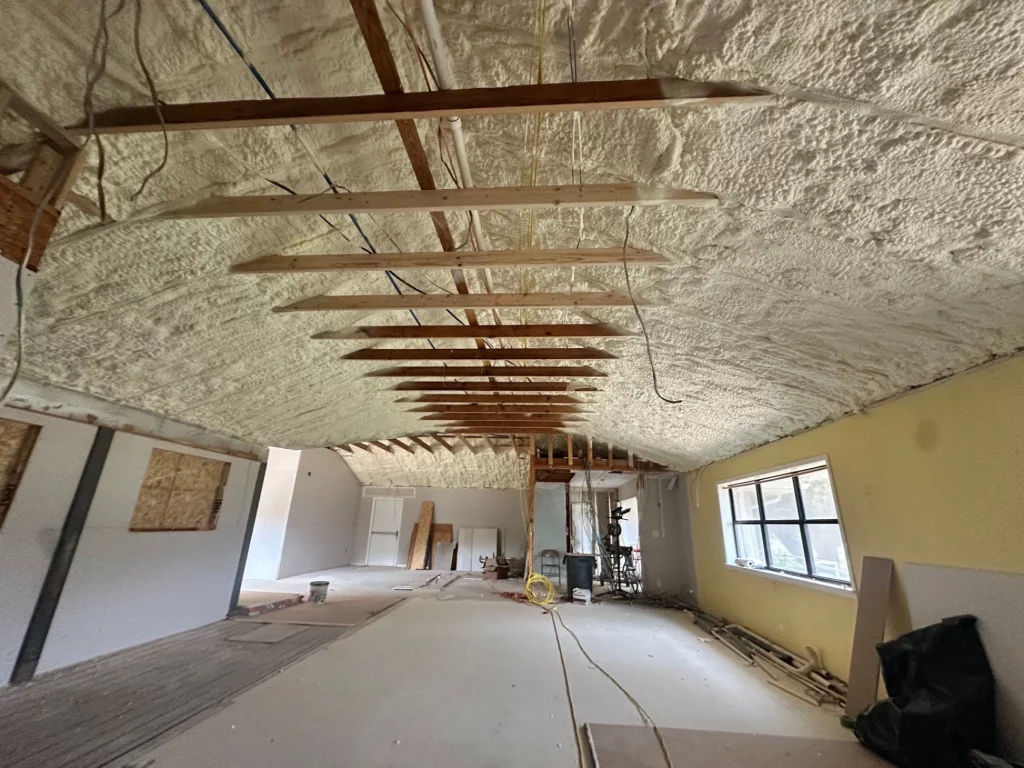
Closed-cell spray foam delivers one of the highest R-values per inch of any insulation material (approximately R-6 to R-7 per inch) and simultaneously serves as an air barrier and vapor retarder. In Austin’s hot-humid climate, this triple function is especially valuable. When applied to the underside of a roof deck in an unvented attic assembly, spray foam keeps the attic space within the conditioned envelope, which is a strategy recommended across multiple Building America assemblies for Zone 2A. This eliminates the extreme attic temperatures that plague vented attic designs in Austin summers and reduces duct losses when HVAC equipment is located in that space.
For commercial buildings with concrete masonry unit (CMU) walls, which are common in Austin retail and warehouse construction, closed-cell spray foam applied inside the block cores provides both insulation and an effective air and moisture barrier. The material also adds structural rigidity to the wall assembly.
Radiant Barriers: Targeting Solar Heat Gain
Unlike traditional insulation that resists conductive heat flow, radiant barriers work by reflecting radiant energy away from the building. According to the DOE’s Energy Saver guide, radiant barriers are more effective in hot climates, and some studies show they can lower cooling costs 5% to 10% in warm, sunny regions. In Austin, where cooling air ducts are often located in attics or mechanical rooms, radiant barriers can meaningfully reduce the heat those duct systems absorb.
Radiant barriers are most commonly used in attics with foil-faced materials installed on the underside of the roof deck or on the attic floor. In commercial metal building construction, reflective insulation is frequently installed as part of the roof and wall panel systems. The reduced heat gain may even allow for a smaller air conditioning system during initial design, which reduces upfront equipment costs.
Rigid Foam Continuous Insulation: Eliminating Thermal Bridging
Standard cavity insulation like fiberglass or mineral wool only fills the spaces between structural framing. In a typical commercial wall with steel studs, thermal bridging through the framing can reduce the effective R-value of the wall assembly by 40% or more. Continuous rigid foam insulation installed on the exterior of the wall sheathing addresses this problem by wrapping the entire building in a layer of insulation with no thermal breaks.
In Austin, continuous insulation with polyisocyanurate (polyiso) board is a practical choice for above-grade commercial walls. Polyiso offers high R-value, a built-in foil facing that also acts as a radiant barrier, and compatibility with common cladding systems. It pairs well with interior cavity insulation to achieve the combined R-values needed to exceed code.
What the DOE Recommends for Hot-Humid Commercial Construction
The DOE’s Building America program has developed optimized climate solutions for hot-humid regions that serve as practical benchmarks for commercial projects. While originally designed for residential construction, the principles translate directly to smaller commercial buildings and light-frame commercial construction.
The DOE’s hot-humid climate solutions recommend these thermal enclosure targets:
- High-R ceilings: R-30 minimum, achieved through unvented attic assemblies with spray foam, above-deck rigid foam, or SIP roof panels
- High-R walls: R-13 cavity insulation plus R-5 continuous exterior insulation, or equivalent spray foam assemblies
- High-R windows: U-factor of 0.33 or lower with solar heat gain coefficient (SHGC) of 0.2 or lower
- Air tightness: 2.5 ACH50 or lower, which requires a continuous air barrier verified through blower door testing
These targets represent a performance level that achieves roughly 30% energy savings above baseline code. For commercial developers in Austin targeting LEED certification, utility incentives, or lower tenant utility costs, hitting these benchmarks during construction is far more cost-effective than retrofitting later.
Moisture Management: The Hidden Challenge
Austin’s average relative humidity of 67% means moisture is a constant concern in commercial wall and roof assemblies. When warm, humid outdoor air meets a cooler interior surface, condensation can form within the wall cavity. Over time, this leads to mold growth, structural degradation, and reduced insulation effectiveness.
In hot-humid climates, the DOE and building science experts recommend placing vapor retarders and air barriers on the exterior side of the assembly in many cases, or using materials that are vapor-open to allow assemblies to dry in both directions. Closed-cell spray foam used at the roof deck in unvented attic designs manages this by keeping the roof assembly above dew point temperatures. For walls with cavity insulation, a smart vapor retarder or class III vapor barrier on the interior side combined with proper exterior drainage planes prevents moisture from accumulating.
Recommendations by Building Type
| Building Type | Recommended Insulation Strategy | Key Considerations |
|---|---|---|
| Office buildings (2-5 stories) | Open-cell spray foam in walls + rigid continuous exterior insulation; unvented attic or flat roof assembly with polyiso above deck | Prioritize SHGC ratings on windows facing south and west; budget for mechanical ventilation with the tight envelope |
| Retail and restaurants | Closed-cell spray foam on CMU block walls; radiant barrier in stockroom attics; rigid foam on steel stud walls | Address moisture from kitchen exhaust and high occupant loads; choose mold-resistant insulation in humid zones |
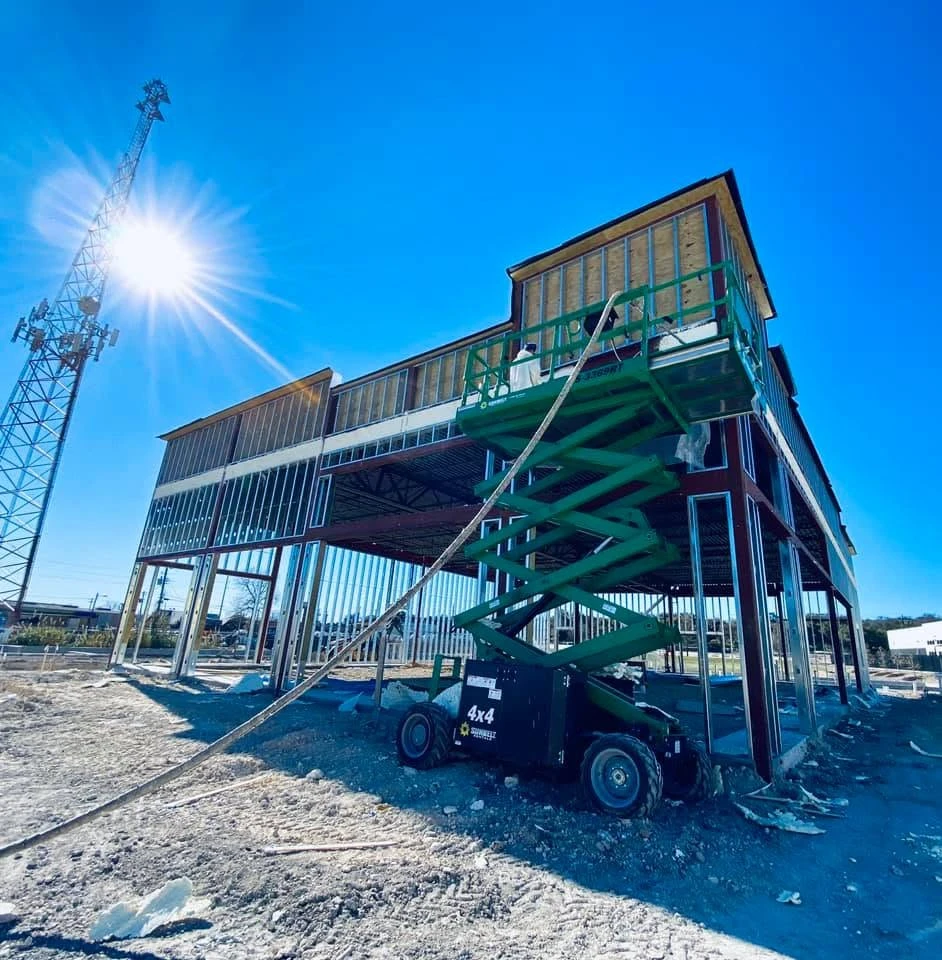
| Warehouse and distribution | Spray foam or insulated metal panels for roof and walls; reflective insulation for metal roofing systems | Large roof areas make radiant heat gain a major factor; consider cool roof coatings in addition to insulation |
| Medical and healthcare | Higher R-value assemblies; closed-cell spray foam for air barrier continuity; mineral wool for fire-rated partitions | Strict humidity control requirements; redundant moisture management layers; continuous air barrier tested and verified |
| Multifamily residential | Exterior rigid foam or spray foam with mineral wool cavity fill; unvented attic; SHGC 0.2 windows | Sound isolation between units; fire-rated assemblies; energy code compliance for each unit separately |
Signs You Have the Right Insulation Partner
Choosing insulation materials is only half the equation. Installation quality determines whether the specified R-values are actually achieved in the field. Look for these indicators when evaluating an insulation provider for your Austin commercial project:
- They understand Austin’s specific code requirements under the 2021 IECC and can reference the relevant sections without hesitation
- They explain not just what material they recommend but why it fits the specific building type, orientation, and mechanical system design
- They address air sealing and moisture management as core parts of the scope, not optional add-ons
- They provide clear documentation showing how their installation achieves the specified R-values, including thickness verification and coverage calculations
- They coordinate with the general contractor, HVAC installer, and architect to ensure insulation decisions align with the overall building envelope strategy
Get Your Austin Commercial Insulation Project Started
At Stellrr Insulation & Spray Foam, we help developers, architects, and general contractors make the right insulation decisions for commercial new construction in Austin’s demanding climate. Our team understands the local energy code requirements, the science behind heat and moisture management in hot-humid conditions, and how to deliver installations that perform as specified on day one and for decades to follow.
Request a Free Quote | Schedule an Insulation Consultation
Call us directly at 512-520-0044 or email info@stellrr.com to discuss your commercial project’s insulation needs. We will review your plans, identify the most effective insulation strategy for your building type and budget, and provide a detailed scope of work so you can move forward with confidence.
FAQs
What R-value do commercial buildings need in Austin, TX?
Austin falls under IECC Climate Zone 2A, and the 2021 IECC with local amendments sets specific R-value requirements for commercial walls, roofs, and floors. Exceeding minimum code with continuous exterior insulation and higher-performing assemblies is common for projects seeking to reduce long-term energy costs.
Is spray foam insulation worth it for commercial construction in Austin?
Spray foam insulation provides both high R-value and an integrated air barrier, which is valuable in Austin’s hot-humid climate where preventing air infiltration of warm, humid outdoor air directly reduces cooling loads. It is particularly effective in unvented attic assemblies and CMU wall construction.
Does radiant barrier insulation work in commercial buildings?
Radiant barriers reflect radiant heat and can lower cooling costs by 5% to 10% in warm, sunny climates according to the DOE. They are well suited for attics and metal building roof assemblies where solar heat gain through the roof is a primary load driver.
How does Austin’s humidity affect insulation choices?
High humidity means moisture management is as important as thermal resistance. Insulation materials that also serve as air and vapor barriers, like closed-cell spray foam, help prevent condensation within wall and roof assemblies. Materials that allow drying, like open-cell foam and mineral wool, are preferred in certain applications.
Can insulation choices reduce HVAC equipment costs in commercial construction?
A well-insulated and air-sealed building envelope reduces the cooling load, which can allow HVAC engineers to specify smaller, less expensive equipment. This is especially relevant in Austin where cooling is the dominant energy load for most of the year.
Sources
- Wikipedia – Austin, Texas – Comprehensive climate data for Austin including temperature averages, humidity levels, precipitation, and IECC climate zone classification.
- Building America Solution Center – Hot-Humid Optimized Solutions – DOE-recommended thermal enclosure targets for hot-humid climates including R-values, air tightness, and window specifications.
- Specta – Austin, TX Building Codes and Permits – Austin’s adopted building codes including 2021 IECC with local amendments and Climate Zone 2A designation with Green Building overlay.