Poor commercial insulation forces HVAC systems to compensate for constant heat loss and gain through walls, roofs, and gaps in the building envelope, driving up energy consumption and monthly utility bills. The Department of Energy – Insulation confirms that insulation provides resistance to heat flow and that properly installed insulation directly reduces heating and cooling costs. When insulation is missing, degraded, or poorly installed, conditioned air escapes and outside air infiltrates, meaning the building never reaches thermal equilibrium. The result is equipment running longer cycles, higher peak demand charges, and energy waste that compounds every month; the problem goes unaddressed.
TLDR: Key Takeaways
- Buildings account for roughly 40% of total energy consumption in the United States, making insulation a primary lever for cost reduction.
- Air leakage through poorly sealed commercial building envelopes can increase heating and cooling energy consumption by as much as 2% to 36%, depending on climate zone.
- The DOE estimates that air leakage through building envelopes accounted for 6% of all energy consumed by commercial buildings in 2010.
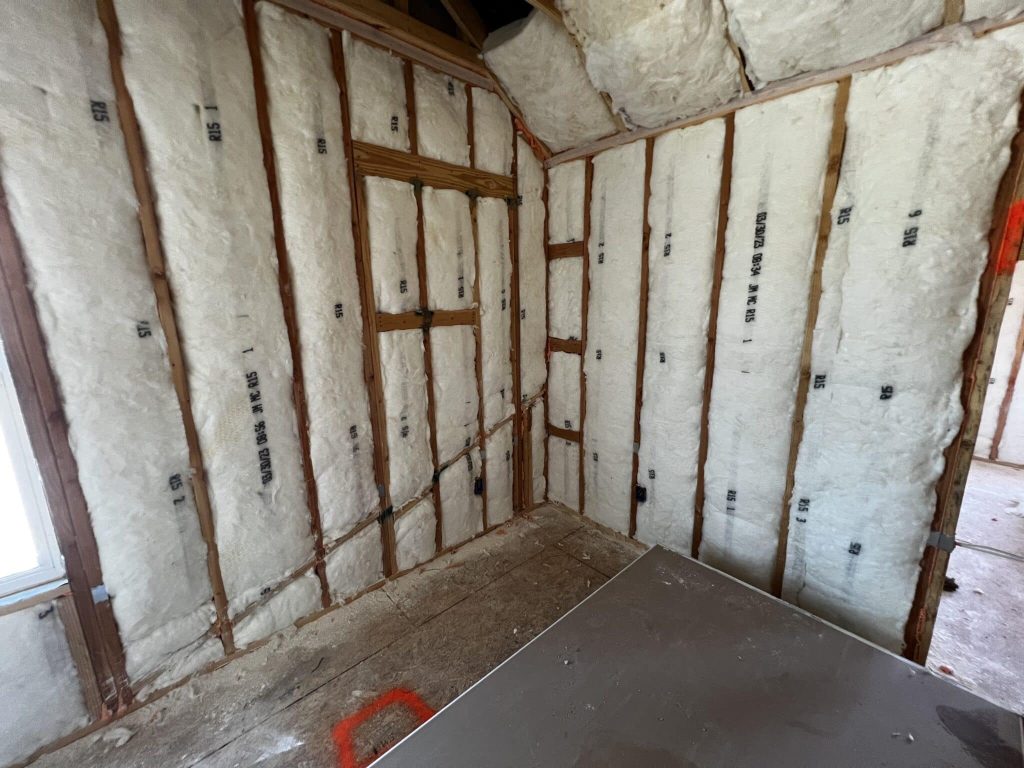
- Traditional insulation, like fiberglass batts and blown-in cellulose, leaves gaps around studs, joists, and penetrations, allowing convective heat loss and air infiltration.
- Spray foam insulation simultaneously provides thermal resistance, an air barrier, a moisture barrier, and structural support in a single application.
- Closed-cell spray foam delivers R-6.5 to R-7 per inch, while open-cell spray foam provides approximately R-3.5 to R-3.8 per inch.
- ASHRAE Standard 90.1 sets minimum R-value and air barrier requirements for commercial buildings, and going beyond these minimums often delivers attractive returns on investment.
Why Commercial Buildings Lose Energy Through Poor Insulation
Most commercial structures, whether office buildings, warehouses, retail spaces, or medical facilities, share a common vulnerability: their building envelopes are not continuous thermal barriers. Traditional insulation materials such as fiberglass batts, mineral wool rolls, and blown-in cellulose are designed to slow conductive heat flow. Still, they do little to stop air movement through gaps, cracks, and penetrations around plumbing, electrical runs, framing members, and roof-to-wall transitions.
According to the Department of Energy – Types of Insulation, the overall R-value of a wall or ceiling assembly is lower than the rated R-value of the insulation itself because heat flows more readily through studs, joists, and other structural elements, a phenomenon known as thermal bridging. In commercial buildings with steel framing, this effect is even more pronounced. Steel conducts heat far more efficiently than wood, creating thermal shortcuts that bypass the insulation entirely.
The NIST – Investigation of the Impact of Commercial Building Envelope Airtightness on HVAC Energy Use conducted simulation studies across multiple U.S. cities and building types. Their findings showed that typical U.S. commercial buildings are not particularly airtight, and envelope leakage contributes to significant heating and cooling loads. Predicted potential annual heating and energy cost savings from improved airtightness ranged from 2% to 36%, with the smallest savings occurring in cooling-dominated climates like Phoenix and Miami.
Beyond direct energy loss, poor insulation creates cascading operational problems. HVAC equipment sized for a reasonably tight building must work harder to maintain setpoints in a leaky one, shortening equipment lifespan and increasing maintenance frequency. Temperature stratification, where floors are cold and ceilings are hot, leads to tenant complaints and productivity losses in office environments.
How Air Leakage Compounds Insulation Problems
Air leakage and inadequate insulation are closely linked but distinct problems. Insulation slows heat transfer through solid materials. Air sealing prevents conditioned air from escaping and unconditioned air from entering. A building can have the R-value required by code and still waste enormous amounts of energy if the envelope is not properly sealed.
The NIST infiltration research page notes that air leakage through building envelopes accounted for 6% of the total energy consumed by commercial buildings in 2010. This figure represents billions of dollars in wasted energy annually across the commercial sector. Air barrier requirements are now included in ASHRAE Standards 90.1 and 189.1, reflecting a growing recognition that insulation alone is not enough.
Common air leakage paths in commercial buildings include:
- Roof-to-wall intersections and parapet transitions
- Window and door perimeters
- Electrical and plumbing penetrations through exterior walls
- Joints between different wall assembly materials
- Expansion joints and control joints in concrete or masonry walls
- Unsealed top plates and soffit areas
Each of these leakage points represents a direct path for energy to leave the building. When combined with insufficient insulation, the energy penalty multiplies.
Spray Foam Insulation: The All-in-One Building Envelope Solution
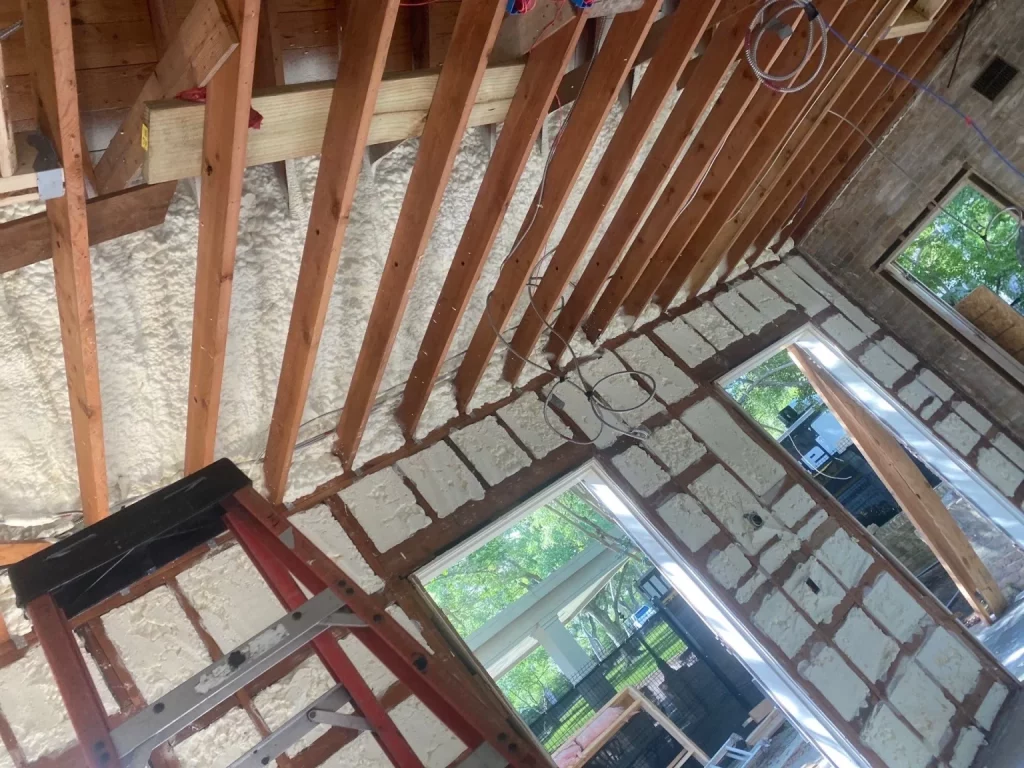
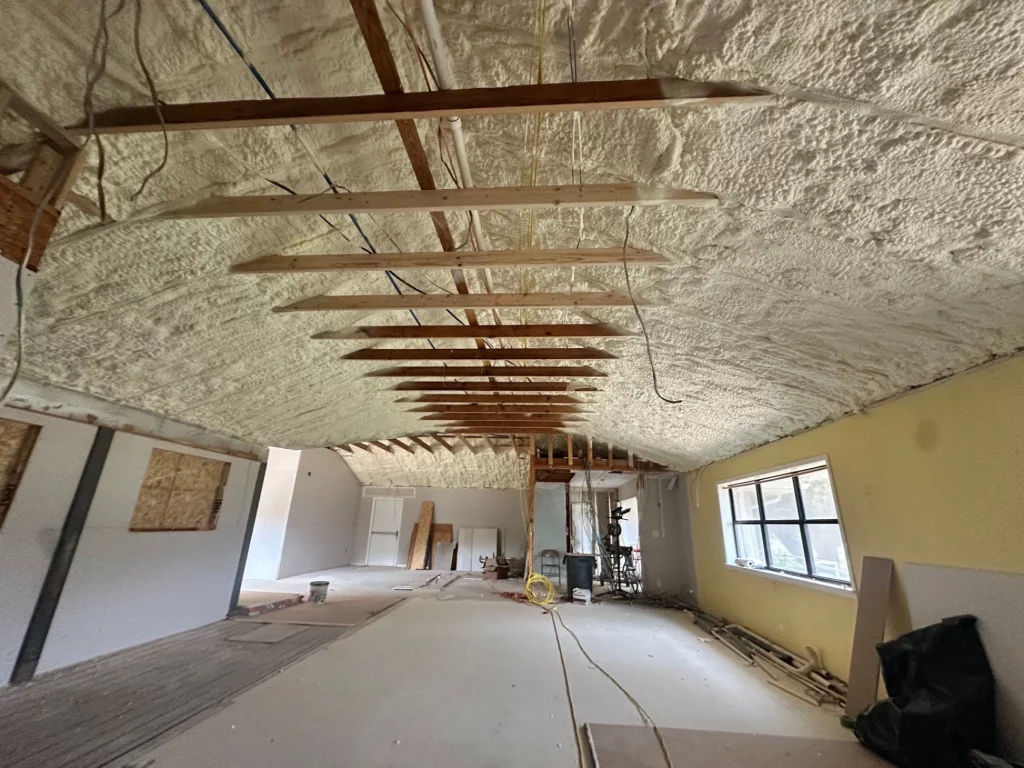
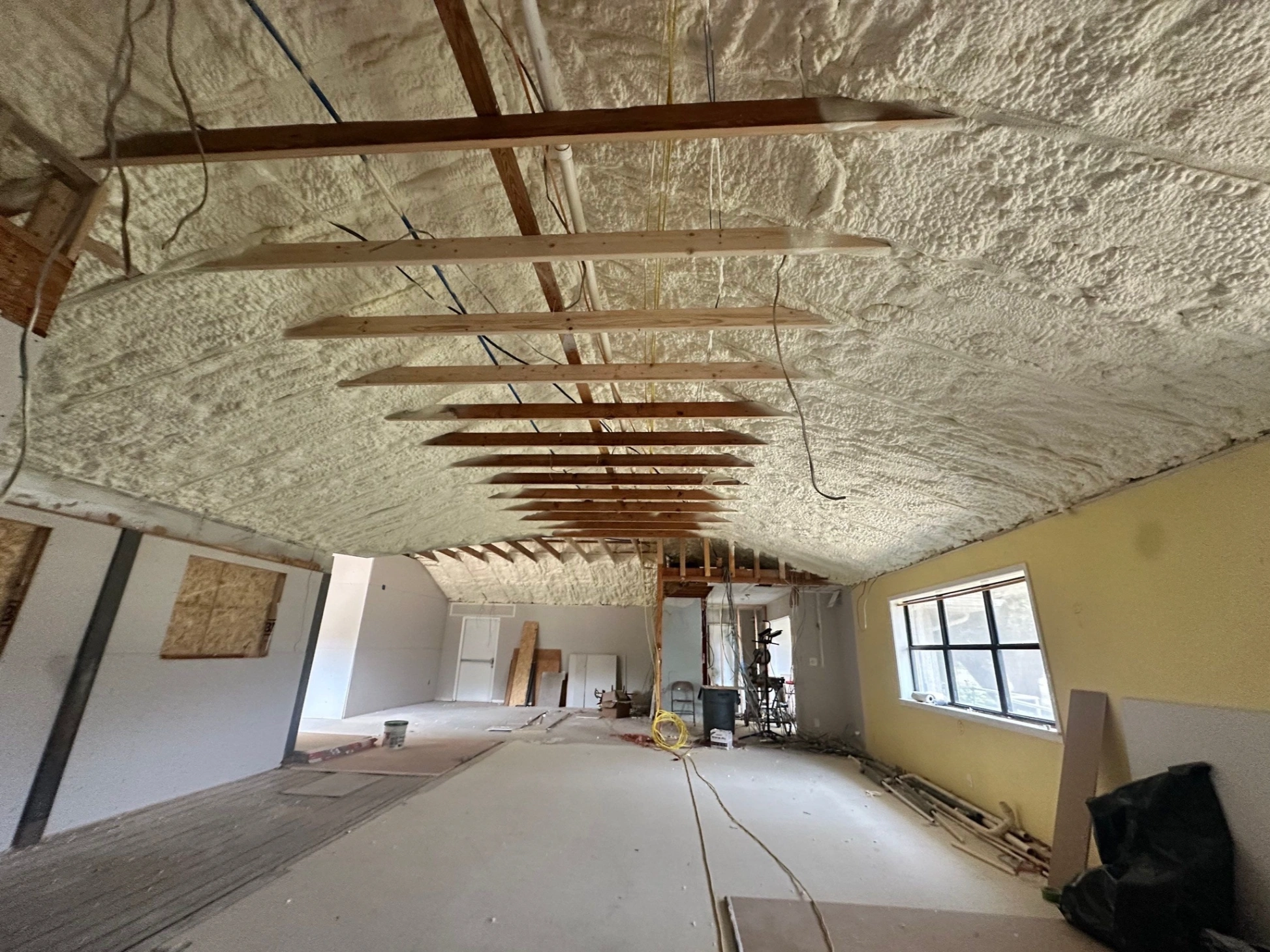
Spray foam insulation addresses both thermal resistance and air leakage in a single application. The Building Science Corporation – Commercial Spray Foam Guide identifies spray polyurethane foam as uniquely capable of providing continuity across all four principal control layers: water control, air control, vapor control, and thermal control. No other common insulation material performs all four functions simultaneously.
When spray foam is applied, it expands to fill cavities, gaps, and irregular surfaces, creating a monolithic barrier that conforms to the exact geometry of the building assembly. This eliminates the voids, compression gaps, and bypass pathways that plague traditional insulation systems.
Closed-Cell vs. Open-Cell Spray Foam
Understanding the differences between the two types of spray foam helps determine the right solution for each commercial application.
| Feature | Closed-Cell Spray Foam | Open-Cell Spray Foam |
|---|---|---|
| R-Value per Inch | R-6.5 to R-7.0 | R-3.5 to R-3.8 |
| Density | High (approximately 2 lb/ft³) | Low (approximately 0.5 lb/ft³) |
| Air Barrier | Yes | Yes |
| Vapor Barrier | Yes (Class II vapor retarder) | No (vapor permeable) |
| Water Resistance | High | Low (can absorb water) |
| Structural Strength | Adds rigidity to the wall assembly | Minimal structural benefit |
| Best Applications | Exterior walls, below-grade, roofs, and metal buildings | Interior cavities, sound attenuation, and non-flood-prone areas |
Closed-cell foam is the preferred choice for most commercial envelope applications because it delivers higher thermal resistance per inch, acts as a vapor retarder, resists moisture intrusion, and adds structural stiffness to the assembly. Open-cell foam works well as an acoustical insulation layer in interior partitions or as supplemental cavity fill where moisture risk is low.
How Spray Foam Addresses Energy Code Requirements
The Insulation Institute – Codes and Standards Update: ASHRAE 90.1 reports that buildings account for roughly 40% of energy consumption and 40% of carbon dioxide emissions in the United States. ASHRAE Standard 90.1, the Energy Standard for Buildings Except Low-Rise Residential Buildings, provides minimum requirements for commercial building envelope performance, including specific R-values for walls, roofs, floors, and fenestration based on climate zone.
Spray foam insulation helps commercial buildings meet and exceed these requirements in several ways. Its high R-value per inch allows thinner applications to achieve code-mandated thermal resistance, which is especially valuable in metal buildings and retrofit projects where cavity depth is limited. Because spray foam also serves as the air control layer, it simplifies compliance with air barrier requirements that have been part of ASHRAE 90.1 since the 2013 edition.
For building owners and developers, exceeding the minimum insulation requirements often makes financial sense. The Insulation Institute analysis shows that going beyond code minimums can deliver simple payback periods under four years while reducing greenhouse gas emissions over the life of the building.
Real-World Commercial Scenarios
The following examples illustrate how poor insulation impacts different commercial building types and how spray foam provides measurable improvements.
| Scenario | Building Type | Problem | Solution | Outcome |
|---|---|---|---|---|
| Office Building Retrofit | Two-story office, steel stud walls, built 1985 | Fiberglass batts had settled and compressed over 40 years, creating gaps at the top plates. Energy bills increased year over year despite HVAC upgrades. | Removed damaged batts and applied 2 inches of closed-cell spray foam directly to exterior sheathing, achieving R-13.5 continuous insulation. | Stabilized indoor temperatures, eliminated hot and cold zones, and reduced HVAC runtime by an estimated 25%. |
| Warehouse Metal Building | 15,000 sq ft metal building, used for climate-sensitive storage | No insulation beyond thin fiberglass blankets between purlins. Extreme temperature swings caused product spoilage. | Applied 3 inches of closed-cell spray foam to walls and roof deck, achieving R-21 thermal resistance and a complete air seal. | Reduced temperature fluctuation from a 30°F swing to less than 5°F. Lowered cooling demand during the summer months. |
| Retail Strip Mall | Six-unit retail space, masonry walls with steel stud framing | Air leakage around window perimeters and at parapet-to-roof joints caused drafts and high heating costs. | Sealed all penetrations with spray foam, applied closed-cell foam to wall cavities for continuous insulation. | Tenants reported immediate comfort improvement. The property owner documented lower common-area utility charges. |
| Medical Clinic | Single-story outpatient facility, flat roof assembly | Condensation in the ceiling cavity caused mold growth. Original insulation was wet and ineffective, driving up cooling costs. | Removed compromised insulation, sprayed 2 inches of closed-cell foam on the roof deck as an air and vapor barrier, and added open-cell foam below for sound control. | Eliminated condensation issues, improved indoor air quality, and reduced HVAC energy consumption. |
Actionable Steps for Commercial Building Owners
- Conduct a building envelope audit. Use blower door testing and thermal imaging to identify specific areas of air leakage, thermal bridging, and insulation deficiency. The NIST research on commercial building air sealing retrofits shows that the existing building stock tends to have leakier envelopes than new construction, and substantial energy savings are achievable through targeted retrofits.
- Compare existing insulation performance to current code requirements. Review ASHRAE 90.1 minimums for your climate zone and building type. If your building was constructed before modern energy codes, the gap between current standards and your actual performance is likely significant.
- Prioritize continuous insulation over cavity fill. Thermal bridging through steel studs and concrete slabs can negate much of the benefit from cavity insulation alone. Continuous insulation applied to the exterior face of the assembly or directly to the structural substrate provides more consistent thermal performance.
- Treat air sealing and insulation as a single system. The DOE recommends sealing air leaks before or during insulation installation. Spray foam inherently combines both functions, making it the most efficient single product for envelope improvement.
- Select the right foam type for each assembly. Use closed-cell spray foam on exterior walls, below-grade applications, roof assemblies, and anywhere moisture resistance is required. Reserve open-cell foam for interior sound walls and cavities where vapor permeability is acceptable.
- Ensure proper installation by certified professionals. As the DOE notes, liquid foam insulation requires special equipment and certification. Application quality directly affects thermal performance, adhesion, and long-term durability.
Factors That Affect Spray Foam Performance
Several variables determine how effectively spray foam insulation performs in a commercial building:
- Foam thickness and total R-value. The installed thickness must be sufficient to meet or exceed code requirements for the specific climate zone and building assembly. Simply spraying foam is not enough if the applied depth falls short of the target R-values.
- Installation quality. Proper substrate preparation, correct mixing ratios, adequate temperature during application, and appropriate spray technique all affect foam expansion, cell structure, and adhesion. Poor installation leads to voids, shrinkage, and reduced thermal performance.
- Climate zone classification. Buildings in heating-dominated climates require different insulation strategies than those in cooling-dominated or mixed climates. ASHRAE 90.1 specifies different R-value minimums for each of eight U.S. climate zones.
- Building age and construction type. Retrofitting insulation into an existing building presents different challenges than new construction. Masonry walls, steel stud assemblies, and metal buildings each require specific spray foam application methods.
- Vapor diffusion requirements. In humid climates or buildings with high interior moisture loads, the vapor permeability of the insulation layer matters. Closed-cell spray foam serves as a vapor retarder, while open-cell foam does not. Selecting the wrong type can lead to condensation problems within the wall assembly.
- Control layer continuity. As Building Science Corporation emphasizes, the air, water, vapor, and thermal control layers must be continuous across all transitions, including wall-to-roof, wall-to-foundation, and around window and door openings. Breaks in continuity at any transition undermine the performance of the entire system.
Ready to Reduce Your Commercial Energy Costs
At Stellrr Insulation & Spray Foam, our team specializes in commercial insulation solutions that addresses both thermal resistance and air leakage in one application. Whether you are retrofitting an older building or insulating new construction, our professionals evaluate your building envelope, recommend the right foam type and thickness for your climate zone, and deliver installation that meets or exceeds energy code requirements. Reach out to discuss your specific building needs and let us show you what a properly insulated commercial space feels like.
Call us at 512-520-0044 or email info@stellrr.com to get started on your commercial insulation project. Our team will perform a thorough building envelope evaluation to identify exactly where your energy dollars are escaping and recommend the most effective spray foam solution.
Frequently Asked Questions
How does spray foam insulation reduce commercial energy bills?
Spray foam fills every gap, crack, and penetration in the building envelope, creating a continuous air barrier while delivering high R-value thermal resistance. This reduces the workload on HVAC equipment and eliminates the energy waste caused by air infiltration and exfiltration.
Can spray foam be installed in existing commercial buildings?
Yes. Slow-curing liquid foam formulations are designed to flow over obstructions before expanding and curing, making them effective for empty wall cavities in existing structures. Retrofit applications can be completed without full interior demolition.
Is spray foam insulation worth it for metal buildings?
Metal buildings are especially vulnerable to energy loss because metal conducts heat rapidly, and traditional insulation between purlins often settles or compresses. Spray foam applied directly to the metal substrate provides continuous insulation that resists thermal bridging and seals the envelope completely.
How long does commercial spray foam insulation last?
When properly installed, spray foam insulation lasts the lifetime of the building. It does not settle, sag, or degrade the way fiberglass and cellulose can. Closed-cell foam also resists moisture and does not support mold growth.
Does spray foam insulation require additional vapor barriers?
Closed-cell spray foam acts as a Class II vapor retarder, eliminating the need for a separate vapor barrier in most above-grade wall assemblies. Some building codes may require additional vapor control depending on the climate zone and assembly type. Open-cell foam does not act as a vapor retarder and may require a separate vapor barrier.
Sources
- Department of Energy – Insulation – Comprehensive guide to how insulation works, R-value definitions, and recommended insulation levels by climate zone from the DOE’s Energy Saver program.
- Department of Energy – Types of Insulation – Detailed overview of all insulation types, including sprayed foam, with information on closed-cell and open-cell foam properties, installation requirements, and performance characteristics.
- Building Science Corporation – Commercial Spray Foam Guide – Technical guide authored by Joseph Lstiburek covering spray foam’s role as a unified water, air, vapor, and thermal control layer in commercial building envelopes.
- NIST – Investigation of the Impact of Commercial Building Envelope Airtightness on HVAC Energy Use – NIST simulation study showing that typical U.S. commercial buildings are not airtight and that envelope leakage causes 2% to 36% annual energy cost savings when addressed.
- Insulation Institute – Codes and Standards Update: ASHRAE 90.1 – Overview of ASHRAE 90.1 commercial energy standard requirements, including the finding that buildings account for roughly 40% of U.S. energy consumption and the financial case for exceeding minimum insulation levels.