
Crawl space insulation and crawl space encapsulation address two different problems, even though they are frequently discussed as competing solutions. Insulation targets thermal resistance, slowing heat transfer through floors and walls with materials rated by R-value. Encapsulation seals the entire crawl space with a heavy-duty vapor barrier, closes vents, and often conditions the space to control moisture, humidity, and air quality. For homeowners with damp, vented crawl spaces in humid climates, encapsulation delivers superior long-term protection against mold, wood rot, and energy loss. For homes in dry climates with no moisture issues, insulation alone may be the more cost-effective approach. According to ENERGY STAR, a properly sealed, moisture-protected, and insulated crawl space will increase comfort, save on energy costs, improve the durability of the home, and reduce the potential for moisture problems. The Building Science Corporation has also found that conditioned crawl spaces outperform vented crawl spaces in nearly every category, including safety, health, comfort, durability, and energy efficiency. The best choice depends on your climate zone, existing moisture conditions, budget, and whether the crawl space is vented or unvented.
TLDR / Key Takeaways
- Crawl space insulation costs between $1.50 and $5.00 per square foot, while full encapsulation ranges from $5.00 to $15.00 per square foot, including vapor barrier, sealing, and dehumidification.
- Insulation alone delivers R-value for thermal resistance but does not stop moisture infiltration, which can degrade insulation performance over time.
- Encapsulation seals vents and installs a continuous vapor barrier, reducing indoor humidity by 30-50% and cutting energy costs by up to 20% according to Building Science Corporation’s conditioned crawl space research.
- Fiberglass batts in crawl spaces can sag, absorb moisture, and lose up to 50% of their effective R-value within a few years in humid conditions.
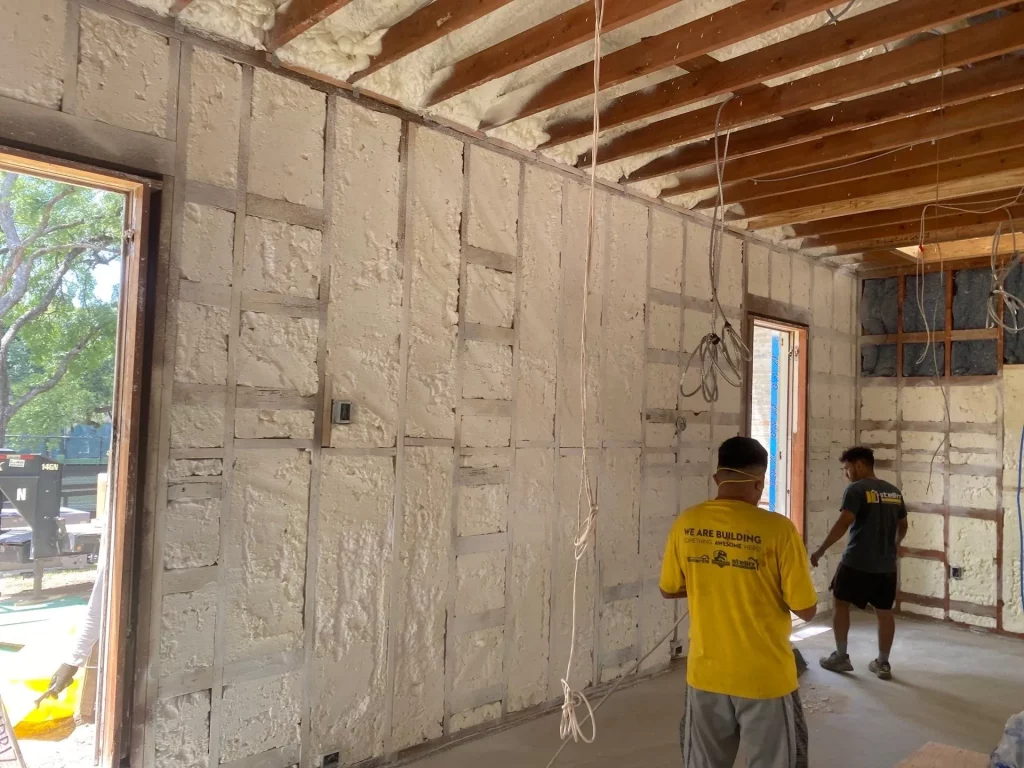
- Closed-cell spray foam applied to crawl space walls delivers R-6 to R-7 per inch, resists moisture, and serves as both insulation and an air barrier.
- Encapsulation is the better long-term investment in climate zones 3 and above, where ground moisture and humidity are persistent issues.
- Insulation alone is a reasonable option for dry climates, homes with sealed crawl spaces, or tight budgets focused on immediate thermal improvement.
- The two approaches are not mutually exclusive. Many high-performance builds combine encapsulation with wall insulation for maximum results.
How Crawl Space Insulation Works
Crawl space insulation focuses on one primary job: thermal resistance. The material slows heat transfer between the crawl space and the living area above. The most common materials used include fiberglass batts, rigid foam boards, and spray foam. Each carries a different R-value, which measures thermal resistance per inch of thickness.
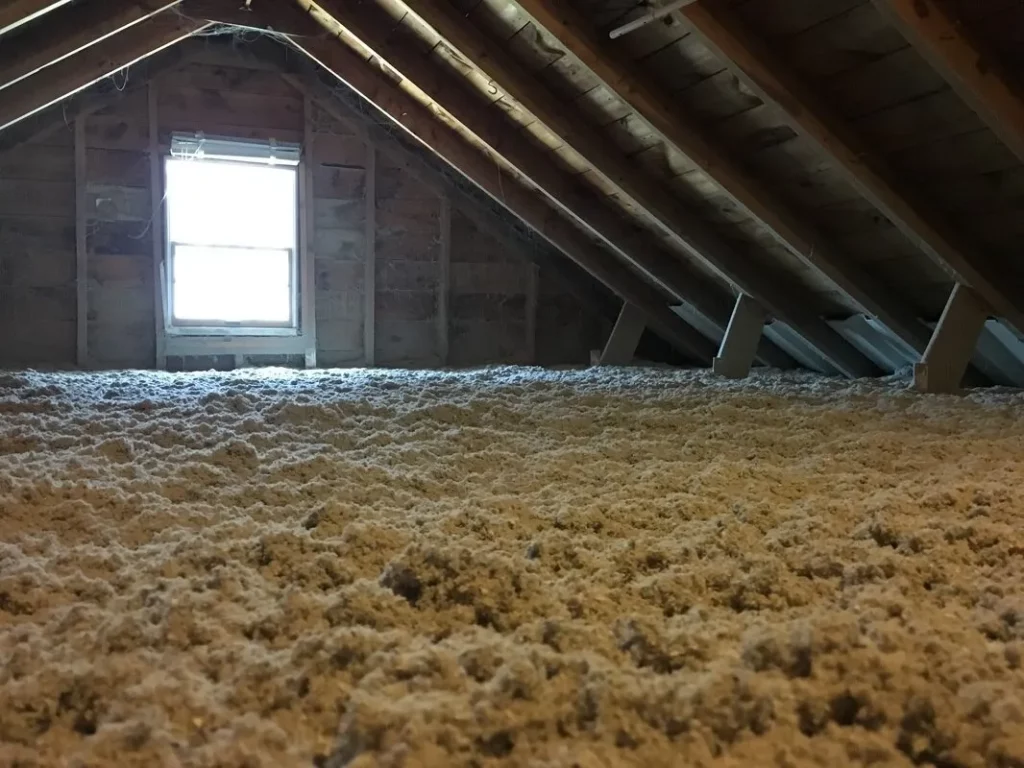
Fiberglass batts are the cheapest option at roughly $0.50 to $1.50 per square foot. They are typically installed between floor joists with the paper or foil facing up against the subfloor. However, fiberglass is porous. In a vented crawl space, warm, humid air enters during the summer months and condenses on cooler surfaces, including the insulation itself. Over time, fiberglass batts absorb moisture, sag, and can harbor mold. The EPA notes that mold thrives in environments with relative humidity above 60%, a condition common in vented crawl spaces across much of the United States.
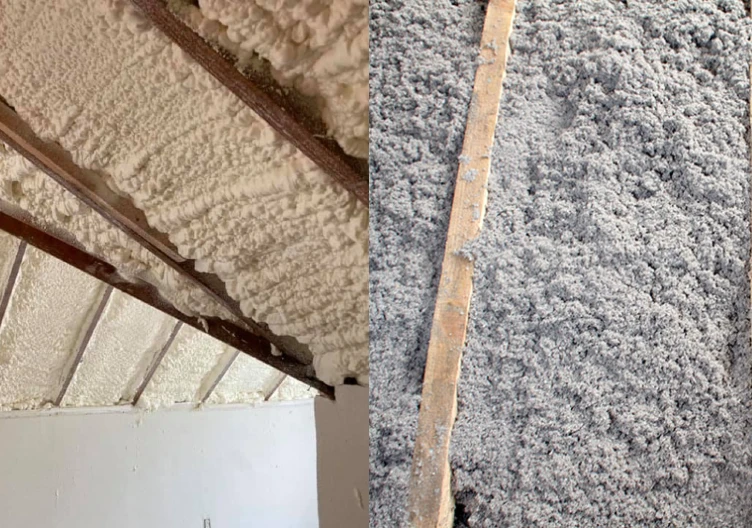
Rigid foam boards, including extruded polystyrene (XPS) and expanded polystyrene (EPS), offer R-values of R-3.8 to R-5.0 per inch. These are resistant to moisture and can be attached directly to crawl space walls. Costs range from $1.00 to $3.00 per square foot for the material alone. They hold their R-value far longer than fiberglass, but do not seal gaps on their own.
Closed-cell spray foam delivers the highest performance at R-6 to R-7 per inch, seals air leaks, and acts as a vapor retarder. It is the most expensive option at $3.00 to $7.00 per square foot but provides the longest service life and the greatest resistance to moisture degradation.
| Insulation Material | R-Value per Inch | Cost per Sq Ft | Moisture Resistance | Lifespan |
|---|---|---|---|---|
| Fiberglass Batts | R-2.9 to R-3.8 | $0.50 – $1.50 | Low | 5-10 years |
| Rigid Foam Board (XPS/EPS) | R-3.8 to R-5.0 | $1.00 – $3.00 | High | 20-50+ years |
| Closed-Cell Spray Foam | R-6.0 to R-7.0 | $3.00 – $7.00 | Very High | 50+ years |
| Open-Cell Spray Foam | R-3.5 to R-3.7 | $1.50 – $3.00 | Low | 15-20 years |
How Crawl Space Encapsulation Works
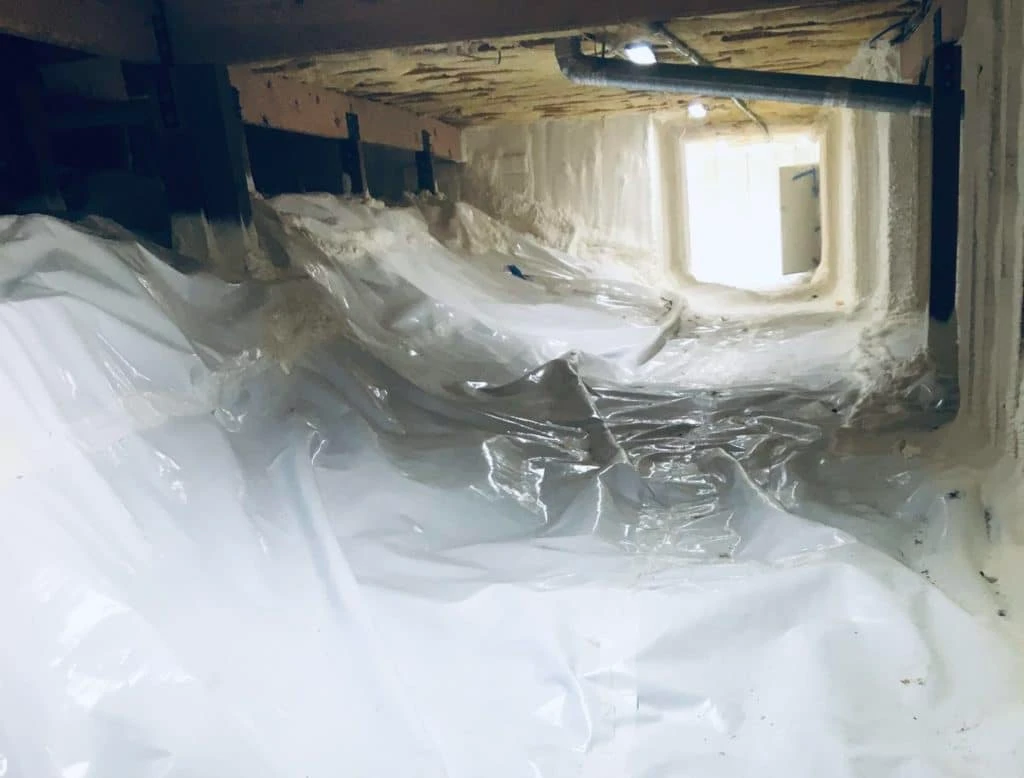
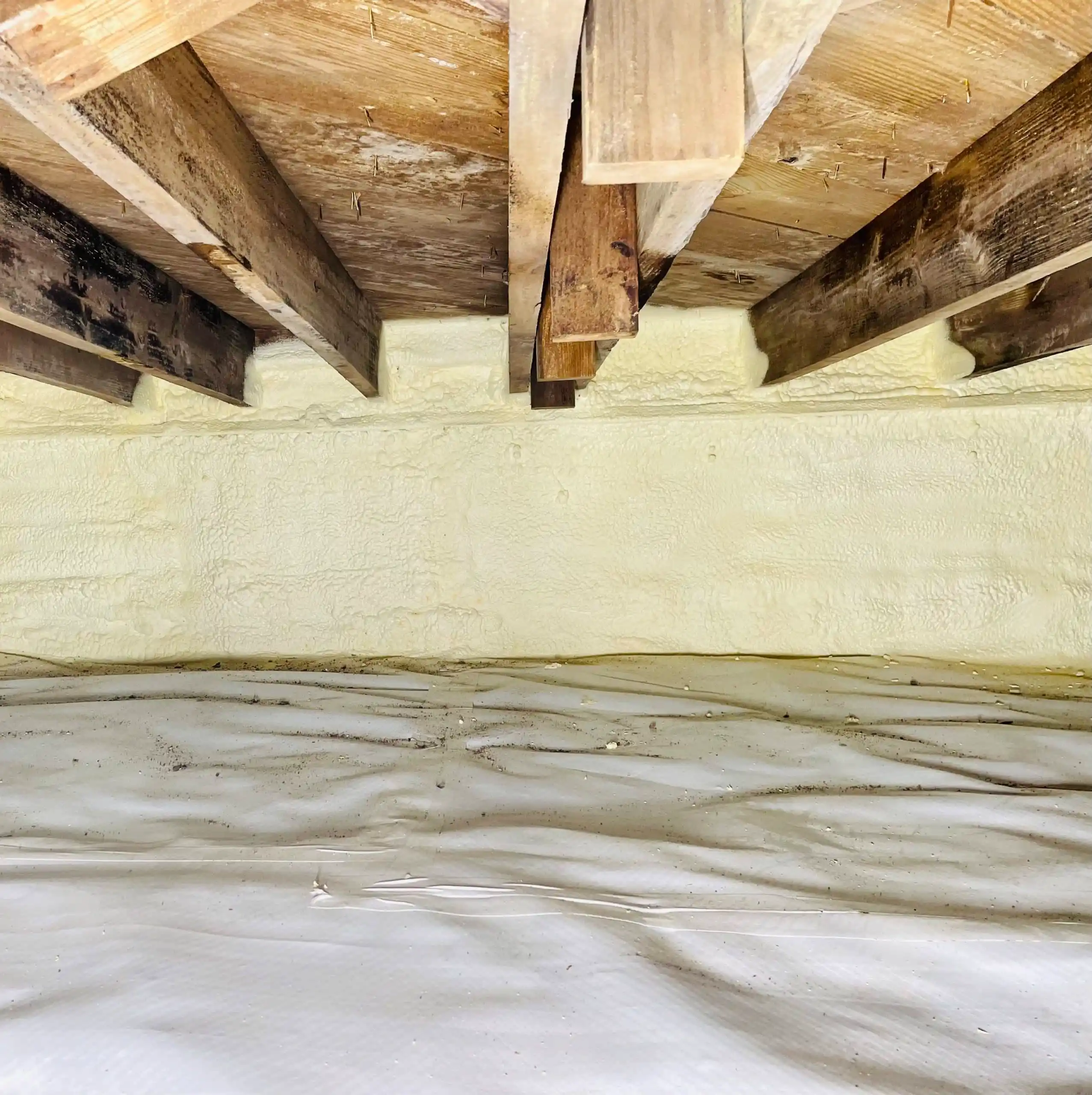
Crawl space encapsulation is a comprehensive moisture management system, not just an insulation method. The process involves sealing the ground with a heavy-duty polyethylene vapor barrier (typically 10 to 20 mil thickness), sealing all vents, sealing rim joists and penetrations, and often installing a dehumidifier to maintain relative humidity below 50-60%.
Encapsulation transforms the crawl space from a vented, outside-air environment into a conditioned or semi-conditioned space that stays dry year-round. This approach addresses the root cause of most crawl space problems: ground moisture evaporation and humid outside air infiltration. According to the Department of Energy’s Building America program, research has shown that vented crawl spaces consistently perform worse than sealed crawl spaces in terms of moisture control, energy consumption, and building durability.
The vapor barrier is the backbone of encapsulation. It covers the entire ground, runs up foundation walls, and is sealed at all seams and penetrations with tape or mastic. Combined with vent sealing and air sealing of the rim joist area, this creates a continuous barrier between the ground and the home’s living space.
Encapsulation alone does not add significant R-value. The vapor barrier has a negligible R-value, which is why many homeowners and contractors pair encapsulation with wall insulation, typically rigid foam board or spray foam, to achieve both moisture control and thermal resistance.
| Encapsulation Component | Function | Typical Cost |
|---|---|---|
| 20 mil Vapor Barrier | Ground and wall moisture barrier | $0.75 – $2.00 per sq ft |
| Vent Sealing | Blocks outside air and humidity | $50 – $150 per vent |
| Rim Joist Air Sealing | Stops air infiltration at floor line | $1.50 – $4.00 per linear ft |
| Dehumidifier | Maintains RH below 50-60% | $1,000 – $2,500 installed |
| Sump Pump (if needed) | Manages groundwater | $1,500 – $3,500 installed |
R-Value Comparison: Insulation vs Encapsulation
This is where the distinction matters most. Insulation provides a measurable R-value. Encapsulation, on its own, provides almost none. But here is the critical detail that many contractors miss: encapsulation preserves the R-value of insulation that is already installed.
In a vented crawl space, fiberglass batts lose thermal effectiveness as they absorb moisture. A wet R-13 batt might perform like an R-6 or less. The same insulation in an encapsulated, conditioned crawl space stays dry and performs at its rated R-value for decades. So while encapsulation does not add R-value directly, it protects the R-value of whatever insulation system is in place.
For the highest thermal performance, the ideal approach is encapsulation combined with closed-cell spray foam on the crawl space walls. This delivers R-10 to R-20 or more, depending on foam thickness, while keeping the space completely dry.
Bar Chart Suggestion: Side-by-side comparison of effective R-value over time for fiberglass batts in a vented crawl space vs rigid foam in an encapsulated crawl space, showing degradation curves over 10 years.
Durability and Long-Term Performance
Durability is where encapsulation pulls ahead decisively. A properly installed vapor barrier with sealed seams and joints can last 20 to 25 years or more with no maintenance beyond periodic dehumidifier filter changes. Spray foam and rigid foam insulation installed on crawl space walls are similarly long-lived because they are not exposed to the gravitational sagging that affects floor joist batts.
Fiberglass batts between floor joists are the least durable option. They sag due to gravity and moisture absorption, fall out of place when disturbed by pests or HVAC contractors, and provide nesting material for rodents. In humid crawl spaces, replacement every 5 to 10 years is common.
Encapsulation also protects structural elements. Maintaining low humidity, it prevents wood rot on floor joists and girders, stops mold growth on framing and subflooring, and reduces the risk of pest infestation. The Building Science Corporation’s research on conditioned crawl space construction confirms that sealed crawl spaces demonstrate significantly better durability metrics than vented alternatives in every climate zone tested.
| Performance Factor | Insulation Only | Encapsulation |
|---|---|---|
| Moisture Control | Minimal to none | Excellent |
| Mold Prevention | Poor to fair | Excellent |
| R-Value Retention | Degrades over time | Maintains rated value |
| Pest Deterrence | Poor | Good to excellent |
| Structural Protection | None | Excellent |
| Indoor Air Quality | Minimal impact | Significant improvement |
| Expected Lifespan | 5-15 years | 20-25+ years |
Real-World Contractor Scenarios
| Scenario | Property Type | Recommended Option | Estimated Cost |
|---|---|---|---|
| 1960s ranch with vented crawl space, standing water, musty smell | Single-family residential | Full encapsulation with sump pump and dehumidifier | $7,500 – $12,000 |
| New construction in dry climate zone 2, sealed crawl space | Single-family residential | Rigid foam wall insulation, no encapsulation needed | $2,000 – $4,000 |
| 1990s two-story with fiberglass batts falling, moderate humidity | Single-family residential | Encapsulation with spray foam on the rim joist and walls | $6,000 – $10,000 |
| Commercial building with a large crawlspace, HVAC ductwork running below | Commercial | Full encapsulation with insulated walls and a dehumidifier | $15,000 – $30,000+ |
| Tight budget homeowner, cold floors, dry crawlspace | Single-family residential | Closed-cell spray foam on floor joist bays | $3,000 – $5,000 |
Factors That Influence the Decision
Several variables determine which approach makes the most sense for a specific property:
- Climate zone: Humid climates in zones 3 through 5 make encapsulation almost always the better choice. Dry climates in zones 1 and 2 may get adequate results from insulation alone.
- Existing moisture conditions: Visible water, mold, or musty odors indicate encapsulation is necessary regardless of budget constraints.
- Crawl space ventilation: Vented crawl spaces benefit enormously from encapsulation. Already sealed crawl spaces may only need wall insulation.
- HVAC ductwork in the crawl space: Ducts in vented crawl spaces lose 15-25% of conditioned air through leaks and conduction. Encapsulation protects these ducts and improves overall HVAC efficiency.
- Budget and project scope: Insulation addresses comfort immediately at a lower cost. Encapsulation requires a larger upfront investment but delivers compounding returns in energy savings, structural protection, and health benefits.
- Building code requirements: Many local codes now require sealed crawl spaces in new construction. Existing homes undergoing renovation may need to meet updated code if permits are pulled.
- Pest history: Homes with recurring rodent or insect problems benefit from the sealed environment that encapsulation creates.
Who Encapsulation Is For (and Who It Is NOT For)
Encapsulation is ideal for:
- Homes in humid climates with vented crawl spaces
- Properties with a history of moisture, mold, or musty odors
- Homes with HVAC ductwork running through the crawl space
- Buildings where indoor air quality is a health priority
- Homeowners planning to stay in the property long enough to recoup the investment through energy savings
Encapsulation is NOT ideal for:
- Homes in extremely dry climates with no moisture history
- Properties where the crawl space is already sealed and conditioned
- Situations with a budget under $3,000
- Homes where the crawl space will need to be accessed frequently for plumbing or electrical work without a proper access door
Get an Expert Assessment for Your Crawl Space
Choosing between insulation and encapsulation is not a one-size-fits-all decision. Every crawl space has different moisture levels, ventilation configurations, and structural conditions that affect which solution delivers the best return on investment. At Stellrr, we evaluate each property individually and recommend the approach that matches the building science, climate conditions, and budget of every project we take on. Reach out to us at info@stellrr.com or call (512) 710-2839 to get started.
Frequently Asked Questions
Can I add insulation to an already encapsulated crawl space?
Yes, and it is often the best approach. Encapsulation handles moisture while insulation on the walls or floor line delivers the R-value needed for comfort and efficiency. The two systems complement each other rather than competing.
Does encapsulation eliminate the need for a sump pump?
Not always. If groundwater naturally accumulates in the crawl space, a sump pump is still necessary to manage active water intrusion. Encapsulation prevents moisture from evaporating into the air but does not stop liquid water from entering if drainage is inadequate.
What R-value do I need for my crawl space?
The International Energy Conservation Code recommends R-10 to R-19 for crawl space walls, depending on climate zone, and R-25 to R-38 for floors over vented crawl spaces. Your local code may vary, so check with your contractor or building department for the specific requirements in your area.
How long does crawl space encapsulation take to install?
A typical residential crawl space encapsulation takes one to three days, depending on the square footage, complexity of sealing, and whether a sump pump or dehumidifier is included. Most standard homes with 1,000 to 2,000 square feet of crawl space can be completed in two days.
Will encapsulation lower my energy bills?
In most cases, yes. Research from the Department of Energy and Building Science Corporation shows that sealed crawl spaces reduce energy consumption compared to vented crawl spaces, with savings of 10-20% on heating and cooling costs depending on the home and climate. The exact savings depend on how much air leakage and duct losses were occurring before the encapsulation.
Sources
- ENERGY STAR – Technology Fact Sheet: Crawlspace Insulation – Guidelines for moisture-protected and insulated crawl spaces covering R-value recommendations, vapor barrier requirements, and best practices for energy efficiency.
- Building Science Corporation – BSI-115: Crawlspaces, Either In or Out – Technical analysis of crawl space design decisions and the building science case for sealed, conditioned crawl spaces.
- EPA Mold Resources – Federal guidance on mold prevention, indoor humidity thresholds, and moisture control strategies relevant to crawl space environments.