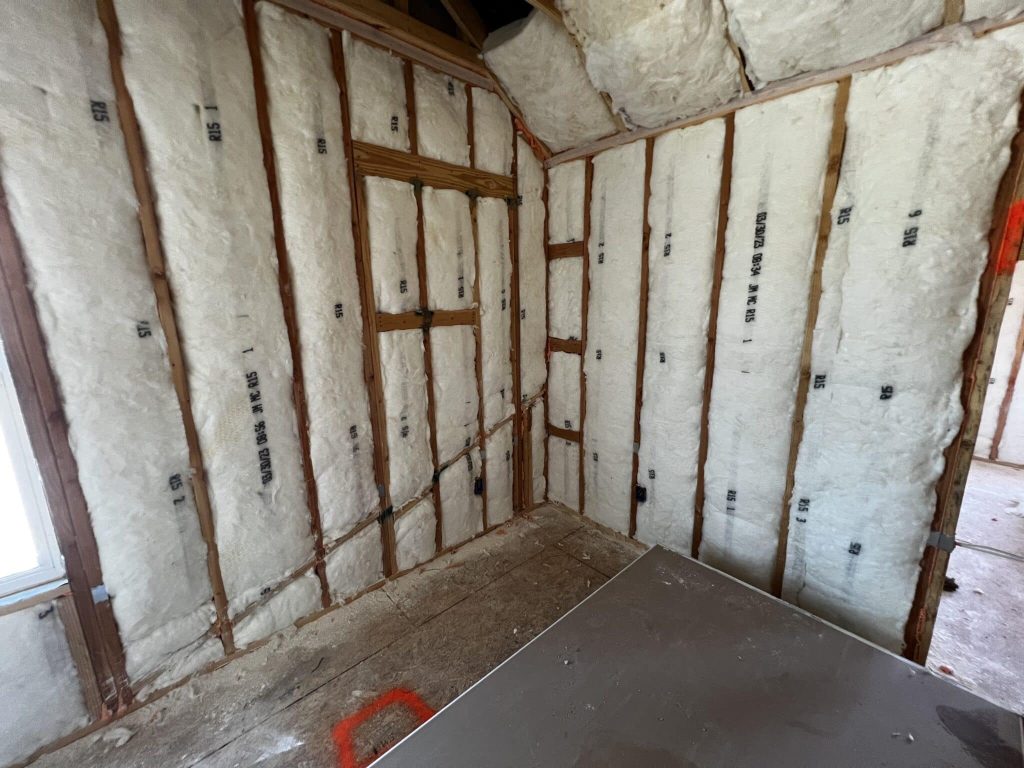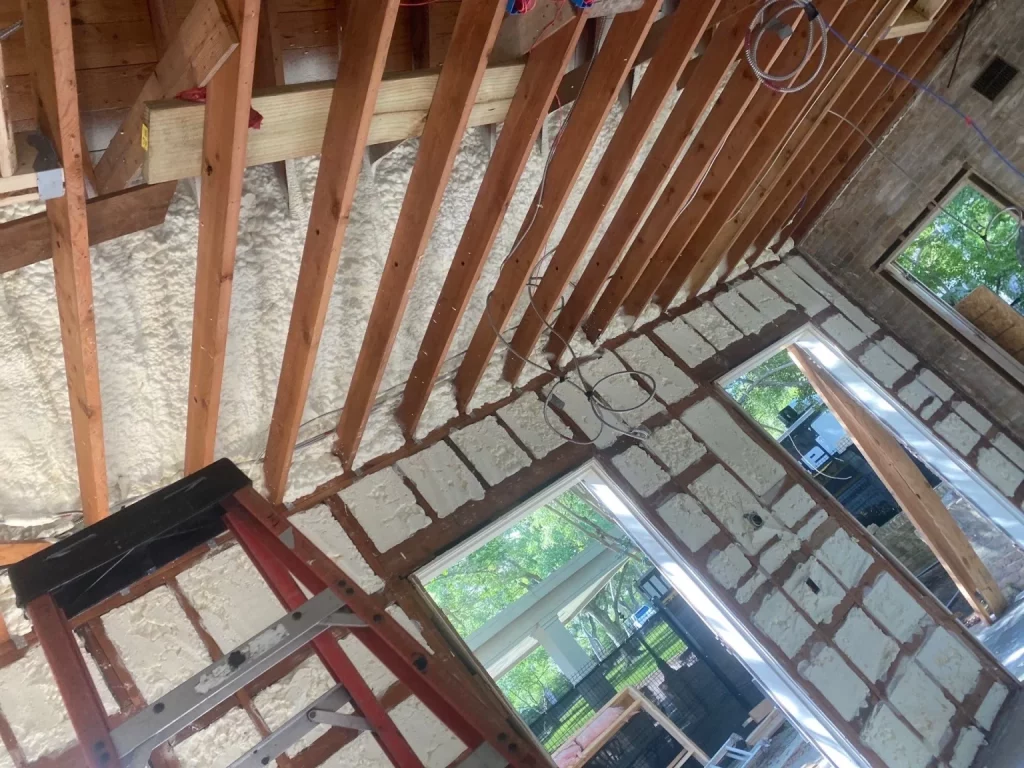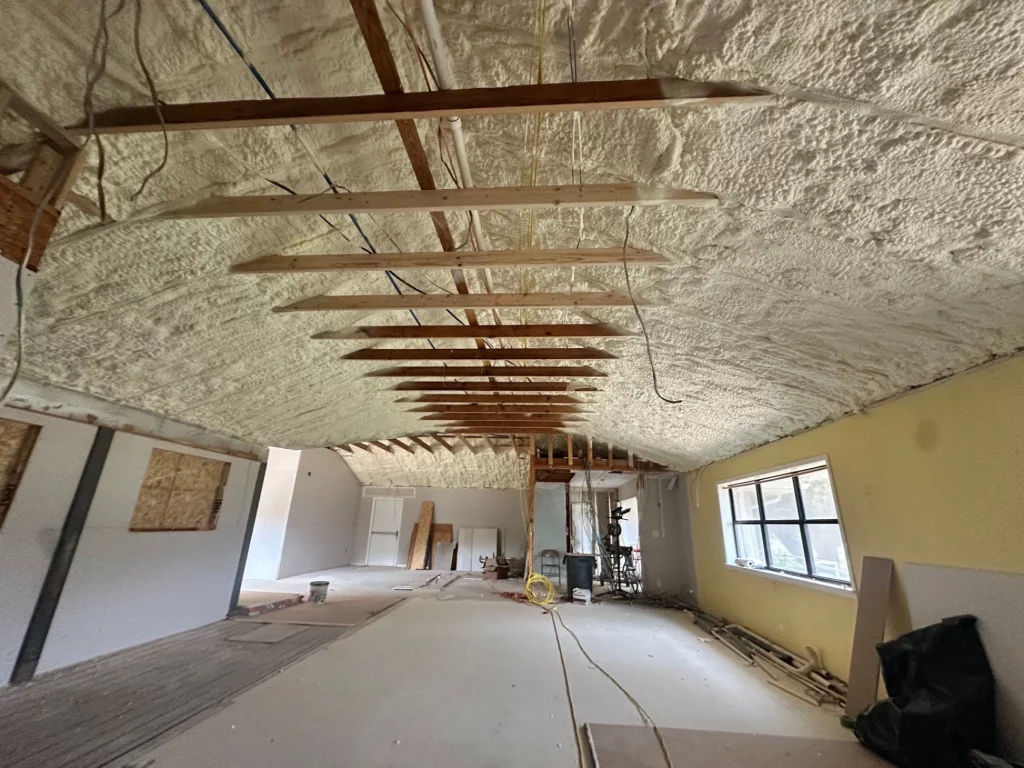
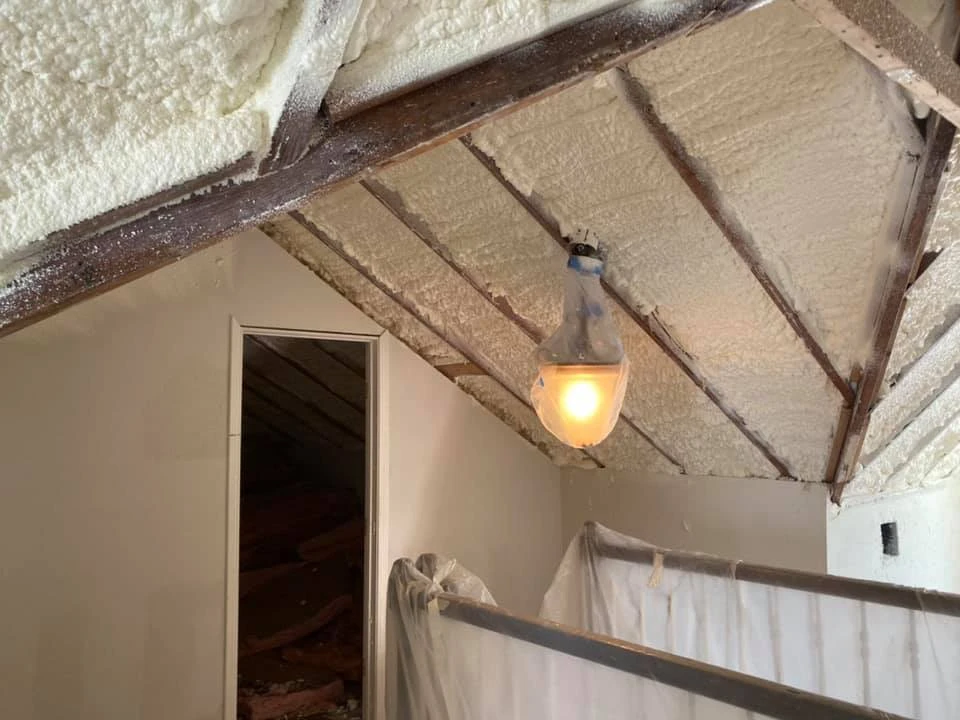
For most commercial buildings, closed-cell spray foam is the stronger all-around choice because it delivers higher R-value per inch (R-6.0 to R-7.5), acts as a vapor barrier, adds structural rigidity, and resists moisture infiltration. Open-cell spray foam costs significantly less upfront and provides better sound attenuation, making it the right pick for interior partitions and budget-sensitive projects. The best answer for your specific commercial building depends on climate zone, moisture exposure, budget, and whether the project demands structural reinforcement, air sealing, or acoustic performance.
According to the U.S. Department of Energy, closed-cell foam has a higher density and offers stronger resistance against moisture and air leakage, while open-cell foam is lighter, less expensive, and should not be used below grade where it could absorb water.
TLDR / Key Takeaways
- Closed-cell spray foam delivers R-6.0 to R-7.5 per inch, roughly double the R-3.5 per inch of open-cell foam
- Open-cell foam typically costs $0.45 to $1.00 per square foot, while closed-cell ranges from $1.00 to $4.50 per square foot
- Closed-cell foam acts as a vapor retarder and air barrier, open-cell foam does not
- Open-cell foam absorbs sound far better, making it ideal for interior walls and office partitions
- Closed-cell foam adds structural strength to wall assemblies, open-cell foam does not
- Most commercial projects use both types strategically: closed-cell on exterior envelopes, open-cell on interior cavities
- The Building Science Corporation confirms that high-density closed-cell SPF is the only product that can perform all four principal control layer functions (water, air, vapor, and thermal)
- ENERGY STAR classifies sprayed foam insulation as an advanced application requiring a certified installer
Head-to-Head Comparison
Understanding the technical differences between these two insulation types helps you make the right call for each zone of a commercial building.
| Property | Closed-Cell Spray Foam | Open-Cell Spray Foam |
|---|---|---|
| R-Value per Inch | R-6.0 to R-7.5 | R-3.5 to R-3.7 |
| Density | 1.5 to 2.0 lb/ft³ | 0.4 to 1.2 lb/ft³ |
| Vapor Barrier | Yes (Class II vapor retarder) | No (vapor permeable) |
| Air Barrier | Yes | Yes |
| Sound Attenuation | Moderate | Excellent |
| Structural Support | Yes (adds rigidity) | No |
| Water Absorption | Minimal | Can absorb water |
| Cost per Sq Ft | $1.00 to $4.50 | $0.45 to $1.00 |
| Expansion Rate | Low (30x liquid volume) | High (100x liquid volume) |
| Best Application | Exterior walls, roofs, below grade | Interior partitions, ceilings |
The R-value advantage of closed-cell foam is significant for commercial buildings where wall thickness may be limited by structural or design constraints. Achieving R-21 in a 2×4 wall with open-cell foam would require roughly 6 inches of material, which is impractical. Closed-cell foam can hit the same target in about 3 inches.
Where Each Foam Type Performs Best
When to Choose Closed-Cell Spray Foam
Closed-cell foam is the right choice for any commercial application where moisture control, structural support, and maximum thermal resistance are priorities. According to the Building Science Corporation’s Commercial Spray Foam Guide, high-density closed-cell spray polyurethane foam serves as the water control layer, air control layer, vapor control layer, and thermal control layer simultaneously when sprayed directly on substrates like block walls or exterior sheathing.
Key applications include:
- Exterior wall assemblies on steel stud or masonry construction
- Below-grade applications such as basement walls and foundation perimeters
- Roof assemblies, particularly unvented or low-slope commercial roofs
- Metal buildings where condensation control is critical
- Climate zones 4 through 8 where heating loads dominate and vapor drive demands a tight envelope
- Buildings with high humidity such as pool facilities, commercial kitchens, or refrigeration warehouses
Closed-cell foam also earns fire-rated assembly certifications. The Building Science Corporation’s guide references UL System No. EWS0015, a 1-hour rated exterior wall assembly using up to 4 inches of high-density closed-cell spray foam with various claddings including brick, stone, and stucco.
When to Choose Open-Cell Spray Foam
Open-cell foam excels where sound control, cost efficiency, and cavity fill matter more than vapor resistance. The same Building Science Corporation guide specifies that low-density open-cell spray foam is well suited for acoustical insulation in steel stud cavities and can achieve a 2-hour separation wall rating with an STC 50 rating using only a single 2×4 wall (UL System U301).
Key applications include:
- Interior partition walls between offices, conference rooms, and retail spaces
- Conditioned unvented roof assemblies with up to 10 inches achieving a 1-hour fire rating (UL P522)
- Sound studios, theaters, and healthcare facilities where noise control is a primary concern
- Budget-sensitive retrofit projects where wall cavity depth allows for thicker application
- Areas where drying potential is important and vapor permeability is beneficial
Cost Breakdown for Commercial Projects
Material cost is often the deciding factor, especially on large commercial projects. Here is a realistic cost framework based on national averages.
| Project Scope | Closed-Cell Estimated Cost | Open-Cell Estimated Cost | Savings with Open-Cell |
|---|---|---|---|
| 10,000 sq ft exterior walls | $10,000 to $20,000 | $4,500 to $10,000 | 30% to 55% |
| 5,000 sq ft roof deck | $5,000 to $15,000 | $2,250 to $5,000 | 50% to 67% |
| 20,000 sq ft interior partitions | $20,000 to $40,000 | $9,000 to $20,000 | 45% to 55% |
| Full building envelope (50,000 sq ft) | $50,000 to $100,000+ | $22,500 to $50,000 | 40% to 55% |
These figures reflect material and installation costs. Actual pricing varies based on geographic location, project complexity, access conditions, and foam thickness requirements. The U.S. Department of Energy notes that foam insulation products and installation usually cost more than traditional batt insulation, but they deliver higher R-values and form an air barrier that can eliminate costs associated with separate weatherization tasks like caulking and housewrap.
Real-World Scenarios
Every commercial building has unique demands. Here are five realistic scenarios showing which foam type makes the most sense.
| Scenario | Property Type | Recommended Option | Why |
|---|---|---|---|
| Metal warehouse in humid climate | Distribution center, Climate Zone 2 | Closed-cell on walls and roof | Vapor barrier prevents condensation on metal surfaces; structural rigidity adds shear strength |
| Office buildout in downtown high-rise | Class A office space, tenant improvement | Open-cell on interior partitions | Superior sound attenuation between offices; lower cost on large partition areas |
| Restaurant renovation | Strip mall retail space | Closed-cell on exterior walls, open-cell on interior | Kitchen humidity controlled by closed-cell; dining area noise managed by open-cell |
| Self-storage facility | Climate-controlled units | Closed-cell on exterior envelope, ceilings | Moisture resistance protects stored goods; high R-value reduces HVAC operating costs |
| Medical clinic new construction | Outpatient facility | Hybrid approach | Closed-cell on exterior and mechanical rooms; open-cell on exam room partitions for patient privacy |
Factors That Influence the Decision
Several variables determine which spray foam type delivers the best return on investment for a specific commercial project.
Climate Zone: Buildings in colder climates (zones 5 through 8) benefit most from the higher R-value and vapor control of closed-cell foam. Insulation R-value requirements are often dictated by the International Energy Conservation Code (IECC) based on the project’s climate zone. In mixed or hot climates (zones 1 through 3), open-cell foam may be sufficient on interior applications where vapor drive is less aggressive.
Moisture Exposure: Any commercial surface exposed to ground moisture, wind-driven rain, or interior humidity requires closed-cell foam. The EPA’s spray polyurethane foam safety guidelines emphasize that proper material selection based on environmental conditions is essential for building performance and occupant safety.
Wall Cavity Depth: When stud or joist cavities are shallow, closed-cell foam maximizes thermal performance within limited space. When cavities are deep, open-cell foam can be applied at greater thickness to reach target R-values at a lower cost per inch.
Fire Code Requirements: Both foam types require an approved thermal barrier such as half-inch gypsum board. However, specific fire-rated assemblies may call for one foam type over the other. Always verify with your local code official and the project’s design team.
Budget Constraints: When the total insulation budget is fixed, a hybrid strategy often delivers the best results. Specifying closed-cell foam where it matters most (exterior envelope, moisture-prone areas) and open-cell foam everywhere else stretches the budget without sacrificing building performance.
Acoustic Requirements: For commercial spaces where sound transmission class (STC) ratings are specified, such as hotels, healthcare facilities, and multi-tenant office buildings, open-cell foam provides measurably better sound absorption.
Who This Is For / Who This Is NOT For
Closed-cell spray foam is the right choice for:
- Commercial buildings in cold or mixed-humid climates requiring strong vapor control
- Metal building construction where condensation management is critical
- Projects where wall thickness is limited and maximum R-value per inch is needed
- Below-grade and foundation applications
- Buildings housing moisture-sensitive operations or stored goods
Closed-cell spray foam is NOT the right choice for:
- Tight-budget projects where open-cell foam can achieve comparable total R-values in deep cavities
- Interior partition walls where sound attenuation is the primary objective
- Applications where the building assembly needs to dry toward the interior
Open-cell spray foam is the right choice for:
- Interior partition walls and office buildouts requiring sound control
- Deep cavity applications where thickness is not a constraint
- Projects prioritizing upfront cost savings over maximum thermal density
- Unvented roof assemblies with adequate cavity depth
Open-cell spray foam is NOT the right choice for:
- Below-grade or below-slab applications where water absorption is a risk
- Exterior walls in climates with significant vapor drive toward the interior
- Metal buildings or surfaces prone to condensation
- Any application requiring a vapor retarder
Safety and Installation Considerations
Spray foam installation in commercial buildings carries specific safety requirements. The EPA warns that exposures to isocyanates and other SPF chemicals in vapors, aerosols, and dust during and after installation can cause asthma, sensitization, lung damage, and other respiratory and skin problems.
Key safety and installation requirements include:
- All spray foam must be applied by trained, certified professionals
- Building occupants must vacate the premises during application and for a specified re-entry period
- Proper ventilation and personal protective equipment are mandatory during installation
- An approved thermal barrier (such as half-inch gypsum board) must cover all spray foam per building code
- ENERGY STAR classifies sprayed foam as an advanced application requiring the highest skill level for installation
Get a Professional Assessment for Your Commercial Building
Choosing between closed-cell and open-cell spray foam is not a one-size-fits-all decision. The right specification depends on your building type, climate zone, budget, moisture conditions, acoustic requirements, and fire code compliance needs. Our team at Stellrr Insulation & Spray Foam evaluates every commercial project individually and recommends the foam type, thickness, and application strategy that delivers the best long-term performance and return on investment. For a deeper understanding of system design and applications, explore this commercial spray foam insulation guide.
Request a Quote | Schedule a Building Assessment
Contact us at info@stellrr.com or call 512-520-0044 to discuss your commercial insulation project. We will walk you through the options, provide a detailed proposal, and make sure your building envelope performs exactly the way it should.
Frequently Asked Questions
Can closed-cell and open-cell spray foam be used together on the same commercial project?
Yes. Most commercial projects use a hybrid approach. Closed-cell foam goes on exterior walls and moisture-critical areas, while open-cell foam fills interior partitions and deep ceiling cavities where sound control and cost savings matter more.
How long does spray foam insulation last in a commercial building?
When properly installed, spray foam insulation lasts the entire life of the building without settling, sagging, or degrading. Both closed-cell and open-cell foams maintain their R-value and performance for decades.
Is spray foam insulation worth the higher upfront cost for commercial buildings?
For most commercial buildings, yes. Spray foam creates a continuous air seal that traditional insulation cannot match, which reduces HVAC energy consumption significantly and lowers operating costs for the life of the building.
Does spray foam insulation require a thermal barrier in commercial buildings?
Yes. All spray foam insulation must be covered with an approved thermal barrier such as half-inch gypsum board to meet fire code requirements, regardless of whether it is closed-cell or open-cell.
What thickness of spray foam do I need for my commercial walls?
Required thickness depends on your climate zone, building code requirements, and target R-value. Closed-cell foam at 2 to 3 inches typically achieves R-14 to R-21, while open-cell foam needs 5 to 6 inches to reach the same thermal resistance. A qualified insulation contractor can calculate the exact specification for your project.
Sources
- U.S. Department of Energy – Types of Insulation – Comprehensive overview of insulation types including sprayed foam, covering closed-cell and open-cell properties, R-values, costs, and installation requirements.
- Building Science Corporation – Commercial Spray Foam Guide – Joseph Lstiburek’s authoritative guide on commercial spray foam applications, covering control layers, fire-rated assemblies, and hybrid insulation strategies.
- International Code Council (ICC) – International Energy Conservation Code (IECC) 2021 – Establishes minimum energy performance standards for residential and commercial buildings, including R-value requirements for insulation based on climate zone.