Closed-cell spray foam insulation stands apart from every other insulation material because it delivers thermal resistance, air sealing, moisture control, and measurable structural reinforcement in a single application. For Austin property owners dealing with intense heat cycles, high humidity, and severe storm risks, this combination makes closed-cell spray foam one of the most practical investments available for protecting and strengthening a building envelope. The right product and application approach depends on your building type, budget, and code compliance requirements, but the structural benefits are well documented across multiple studies and building science organizations.
Key Takeaways
- Closed-cell spray foam delivers R-6.5 to R-7.0 per inch, roughly double the performance of fiberglass per inch of thickness
- Research by the National Association of Home Builders shows closed-cell foam can increase wall racking strength by 200% to 300% compared to uninsulated cavities
- Austin’s adoption of the 2024 International Energy Conservation Code raises building envelope standards, making high-performance insulation more relevant for new construction and renovations
- The Spray Polyurethane Foam Alliance confirms closed-cell foam is the only cavity insulation recognized by FEMA as flood-damage resistant for up to 72 hours of submersion
- Typical installed costs for closed-cell spray foam range from $2.50 to $4.50 per square foot at 2 inches thickness, depending on the application
- All foam plastic insulation must be separated from occupied interior spaces by a half-inch thermal barrier, such as gypsum board, per International Building Code requirements
How Closed-Cell Spray Foam Strengthens Buildings
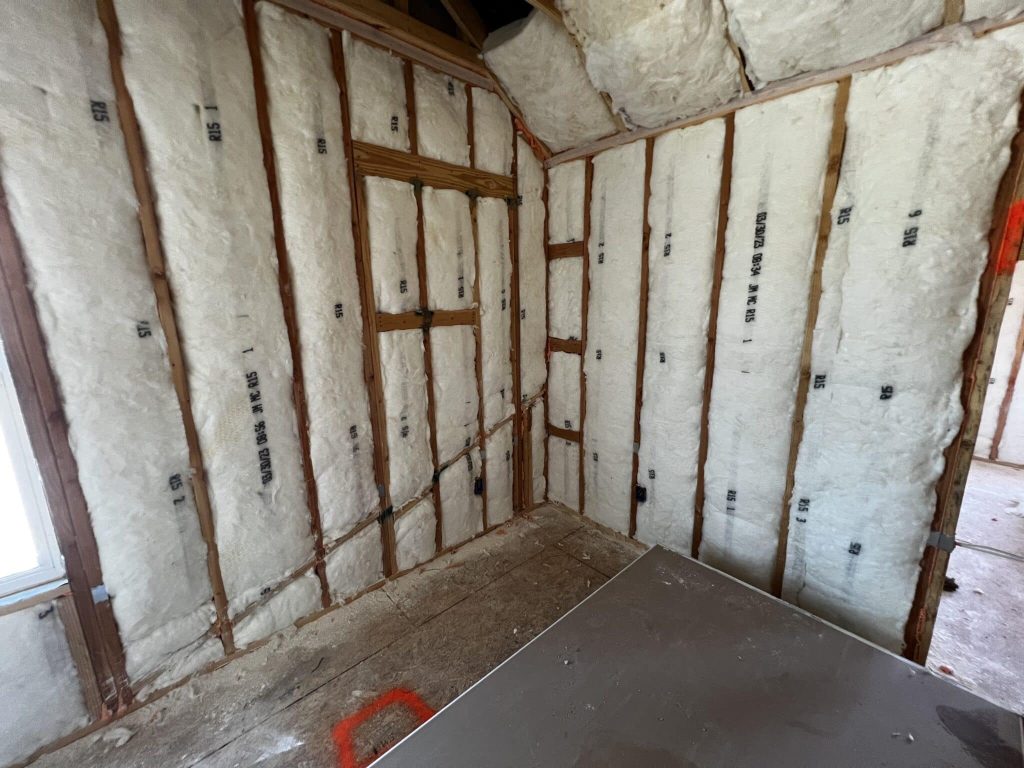
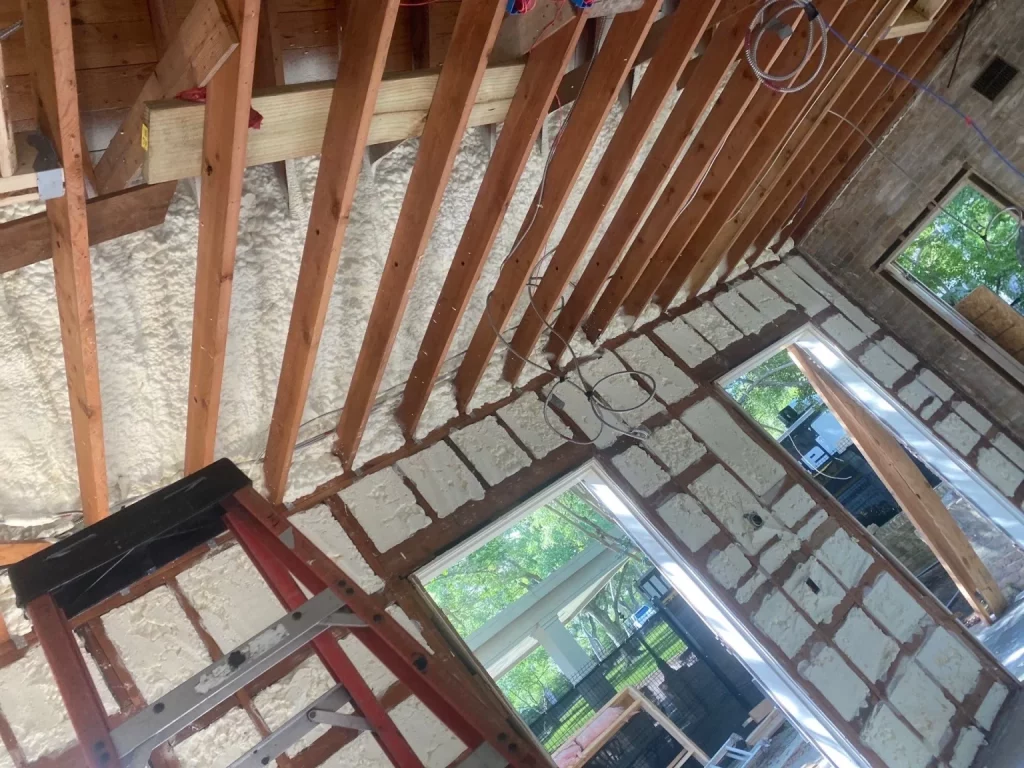
Unlike fiberglass, mineral wool, or open-cell foam, closed-cell spray polyurethane foam cures into a rigid, dense material that bonds directly to framing members, sheathing, and substrate materials. This is why closed-cell spray foam standards are increasingly influencing modern building codes. When sprayed into wall cavities, it adheres to both the interior and exterior faces of the studs, essentially gluing the assembly together. This bonding action dramatically increases the racking resistance of the entire wall system.
According to research documented by the National Association of Home Builders Research Center, walls insulated with closed-cell spray foam showed racking strength increases of 200% to 300% over uninsulated wall assemblies. Racking strength refers to a wall’s ability to resist lateral forces such as wind loads, which is particularly relevant in a region like Austin that experiences severe thunderstorms and tornado threats.
The NREL study on hybrid wall systems confirmed through ASTM E72 testing that full-cavity closed-cell spray foam installations contribute measurable structural capacity to framed wall assemblies. This means the insulation is doing double duty: reducing energy transfer while also helping the structure resist wind and seismic loads.
For roof assemblies, closed-cell spray foam applied beneath the roof deck can improve wind-uplift resistance and serve as a secondary water barrier if the primary roofing material is damaged during a storm. This layered protection has been recognized by the Insurance Institute for Business and Home Safety (IBHS) Fortified Home program.
Why Structural Strength Matters in Austin’s Climate
Austin sits in Climate Zone 2, characterized by hot summers, mild winters, and significant humidity. These conditions create specific challenges for building envelopes:
- Thermal cycling from summer highs exceeding 100 degrees F to occasional winter freezes causes repeated expansion and contraction of framing and cladding materials
- High humidity drives moisture into wall cavities through air leaks, creating conditions for mold growth and wood rot
- Severe storms generate wind loads that test the lateral resistance of exterior walls and roof connections
- Energy costs in Austin are among the highest in Texas, making insulation performance directly tied to monthly operating expenses
The City of Austin adopted the 2024 International Energy Conservation Code with local amendments, reducing the building envelope air leakage target from 5 to 4 ACH50. This tighter standard pushes builders and remodelers toward materials that provide both insulation and air sealing. Closed-cell spray foam meets both requirements in a single step, while also adding the structural reinforcement that conventional insulation cannot provide.
The U.S. Department of Energy Building America program has documented that spray polyurethane foam insulation reduces heating and cooling costs by 30% to 50% compared to traditional insulation in similar buildings, depending on the existing construction quality and climate conditions.
Closed-Cell vs. Open-Cell for Structural Applications
Not all spray foam is equal when it comes to structural performance. The table below compares the two primary types:
| Feature | Closed-Cell Spray Foam | Open-Cell Spray Foam |
|---|---|---|
| R-Value per Inch | R-6.5 to R-7.0 | R-3.6 to R-3.8 |
| Density | 1.5 to 2.5 lb/ft3 | 0.4 to 0.5 lb/ft3 |
| Structural Contribution | High (200-300% racking increase) | Minimal |
| Vapor Retarder | Class II at 2 inches (≤1.0 perm) | Not a vapor retarder |
| Air Barrier | Yes at 1.5 inches | Yes at 3.5+ inches |
| FEMA Flood Resistance | Recognized as flood-damage resistant | Not recognized |
| Best Application | Walls, roofs, crawl spaces, flood zones | Interior walls, sound control, budget projects |
| Typical Installed Cost | $2.50 to $4.50/sq ft at 2 inches | $0.80 to $1.50/sq ft at 3.5 inches |
When structural reinforcement is a priority, closed-cell spray foam is the clear choice. Open-cell foam provides excellent air sealing and sound dampening but lacks the density and rigidity needed to contribute meaningful racking strength.
Where Closed-Cell Spray Foam Delivers the Most Value
Exterior Wall Cavities
Spraying closed-cell foam into exterior wall cavities creates a monolithic bond between studs, plates, and sheathing. This is where the structural benefit is most pronounced. In a typical 2×4 or 2×6 wall assembly, a 2 to 3 inch application fills or nearly fills the cavity, delivering R-14 to R-21 while adding significant shear resistance.
Roof Deck Assemblies
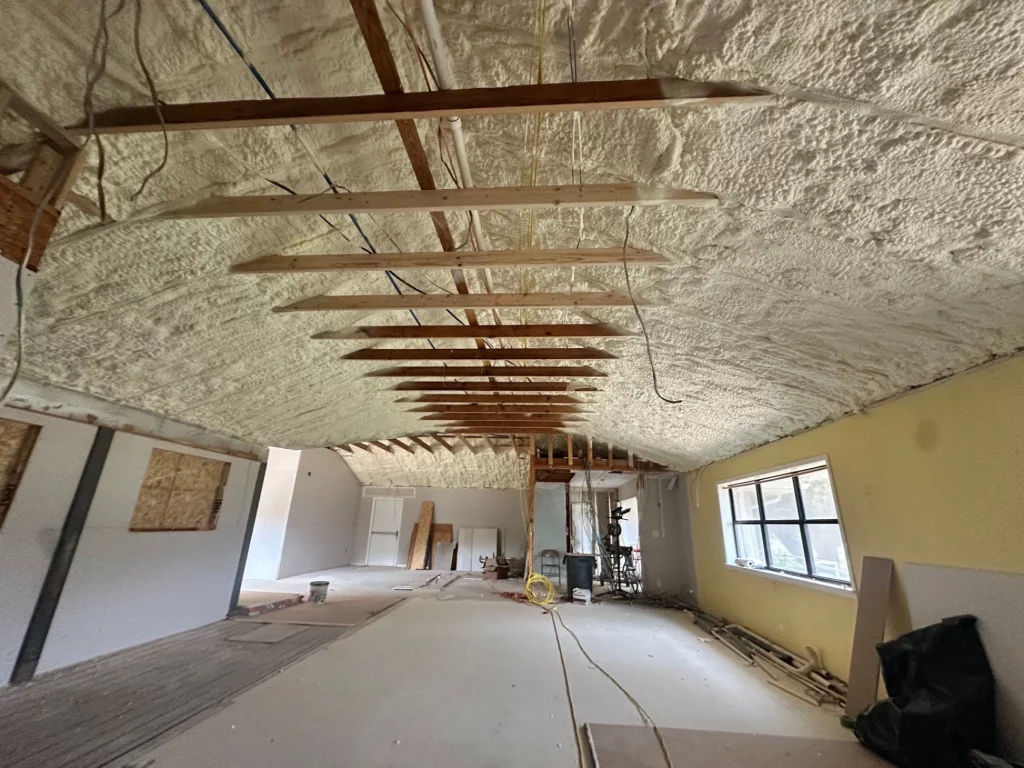
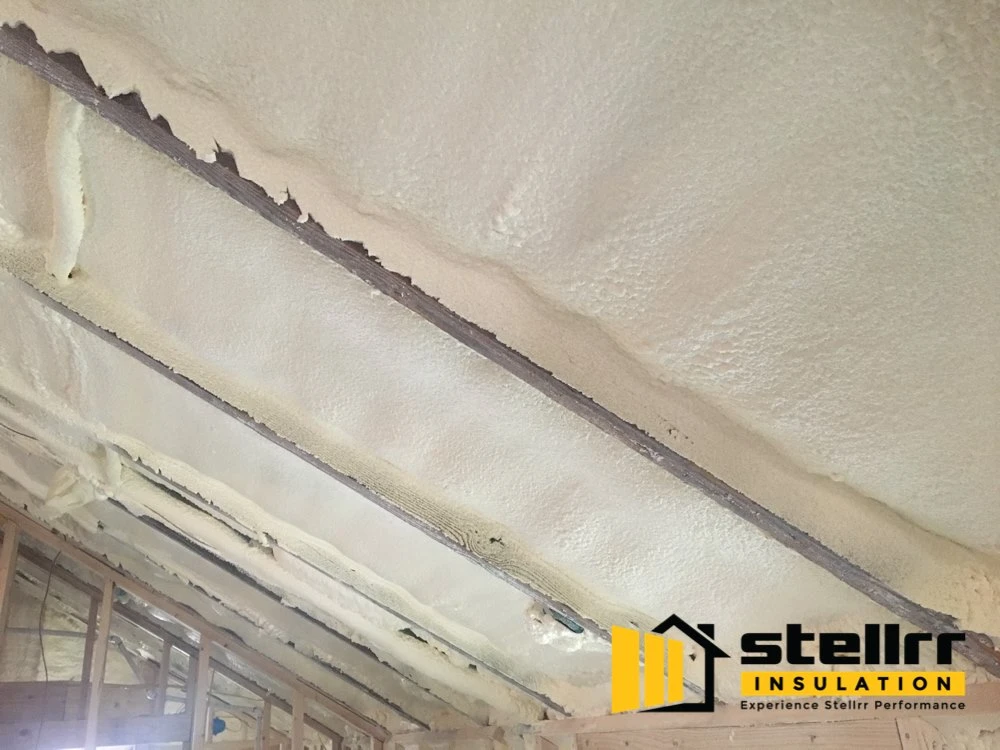
Spray foam applied directly to the underside of the roof deck in unvented attic assemblies strengthens the roof against wind uplift, seals air leaks at framing connections, and eliminates the need for separate attic ventilation. In Austin’s hot climate, moving the insulation boundary to the roof deck keeps ductwork and HVAC equipment within the conditioned space, improving system efficiency.
Crawl Spaces and Flood-Prone Areas
The Spray Polyurethane Foam Alliance confirms that closed-cell spray foam is the only cavity insulation recognized by FEMA as flood-damage resistant. In areas of Austin subject to flooding or high water tables, applying closed-cell foam to crawl space walls and floor joists protects the structure from moisture intrusion and provides structural stiffening to the floor assembly.
Metal Buildings and Commercial Structures
Steel-framed buildings face unique challenges with thermal bridging through steel members. Closed-cell spray foam adheres to metal surfaces, reducing conductive heat transfer while reinforcing the connection between purlins, girts, and metal panels. For warehouses, shops, and light commercial buildings in the Austin area, this dual benefit makes spray foam a common specification.
Real-World Applications in Austin
| Building Type | Application | Typical Investment | Measurable Outcome |
|---|---|---|---|
| New residential construction | Full wall cavity, 2.5 inches | $4,000 to $8,000 (2,000 sq ft home) | 30%+ reduction in HVAC runtime, improved wall stiffness |
| Existing home retrofit | Attic roof deck, 3 inches | $3,500 to $6,000 (1,500 sq ft attic) | Elimination of attic heat gain, secondary water barrier |
| Metal warehouse | Interior wall panels, 2 inches | $6,000 to $15,000 (5,000 sq ft) | Condensation elimination, improved wind resistance |
| Crawl space encapsulation | Crawl space walls and rim joist, 2 inches | $2,000 to $4,000 (1,200 sq ft crawl) | Moisture control, floor stiffness, flood resistance |
| Historic home renovation | Exterior wall injection, varies | $3,000 to $7,000 | Preserved character with modern thermal and structural performance |
How to Evaluate a Spray Foam Contractor in Austin, TX
Choosing the right installer matters as much as choosing the right product. Here are the criteria we recommend assessing:
Questions to ask:
- Are you licensed and insured in the state of Texas, and can you provide certificates of insurance?
- Which spray foam manufacturer do you use, and can you provide ICC-ES evaluation reports for the product?
- Do your installers hold current certifications from the Spray Polyurethane Foam Alliance (SPFA) or an equivalent body?
- How do you handle thermal barrier requirements to meet local building code?
- Can you provide references from projects in the Austin area with similar scope?
What to verify:
- The contractor provides a detailed written estimate specifying board feet, foam thickness, and product name
- The proposed application meets or exceeds the 2024 IECC requirements adopted by the City of Austin, TX
- The contractor follows proper substrate preparation protocols, including moisture testing for concrete and masonry surfaces
- The installation plan accounts for ventilation requirements, especially in tightened building envelopes
Common Mistakes to Avoid
- Choosing foam based solely on price per board foot without verifying the manufacturer’s ICC-ES evaluation report and fire testing data. Not all closed-cell foams perform the same structurally or meet code requirements.
- Skipping the thermal barrier. All foam plastic insulation must be separated from the building interior by an approved 15-minute thermal barrier, typically half-inch gypsum wall board, per IBC and IRC requirements.
- Ignoring moisture conditions. Substrate temperatures should be between 60 and 120 degrees F with relative humidity below 80% during installation. Applying foam to wet surfaces compromises adhesion and structural bonding.
- Not accounting for ventilation. Tightening the building envelope with spray foam requires a corresponding plan for mechanical ventilation to maintain indoor air quality and prevent moisture buildup.
- Overlooking flood zone considerations. In FEMA-identified flood zones, selecting a foam product that meets flood-damage resistance requirements protects your investment and may affect insurance premiums.
Recommendations by Building Type
New residential construction in Austin: Full cavity closed-cell spray foam at 2.5 to 3 inches in exterior walls combined with open-cell or closed-cell at the roof deck line. This approach maximizes structural racking strength while meeting the tighter 4 ACH50 air leakage standard under the 2024 IECC.
Existing residential retrofit: Focus on the attic roof deck first. Most existing Austin homes lose the majority of their conditioned air through the attic. Spraying 3 inches of closed-cell foam to the roof deck addresses the biggest energy loss point while adding wind-uplift resistance.
Commercial and metal buildings: Apply 2 inches of closed-cell foam to the interior of metal panels and structural members. This eliminates condensation, reduces thermal bridging through steel framing, and stiffens the building against lateral loads.
Crawl spaces and below-grade areas: Closed-cell foam on crawl space walls and rim joist areas provides moisture control, structural reinforcement, and FEMA-recognized flood resistance, making it the right call for Austin properties in flood-prone areas.
Signs You Have Found the Right Approach
- Your contractor or insulation specialist explains the structural benefits using specific test data and product specifications rather than vague claims
- The proposed foam product has a current ICC-ES evaluation report confirming compliance with applicable building codes
- The installation plan accounts for Austin’s Climate Zone 2 requirements and the 2024 IECC air leakage standards
- You receive a clear, detailed scope of work specifying board feet, target thickness, product name, and total installed cost
- The contractor addresses ventilation, thermal barrier, and moisture management as part of the complete building science solution
Get Started With Stellrr
At Stellrr Insulation & Spray Foam, our team helps Austin homeowners and builders select and install closed-cell spray foam solutions that deliver measurable improvements in structural strength, energy efficiency, and moisture protection. We take a building science approach to every project, recommending the right product and application thickness based on your specific structure, goals, and budget.
Request a Quote | Schedule a Structural Assessment
Reach our team directly at info@stellrr.com or call 512-520-0044 to discuss your project. We serve residential and commercial properties throughout Austin, TX.
Frequently Asked Questions
How much does closed-cell spray foam cost in Austin, TX?
Installed costs typically range from $2.50 to $4.50 per square foot at 2 inches thickness, depending on the complexity of the project and access conditions.
Does closed-cell spray foam really add structural strength?
Yes. NAHB Research Center testing shows walls with closed-cell spray foam have up to 300% greater racking strength than uninsulated assemblies, because the cured foam bonds framing and sheathing together into a rigid composite.
How thick should closed-cell spray foam be for walls in Austin?
For exterior walls in Climate Zone 2, 2 to 3 inches of closed-cell foam delivers R-14 to R-21, which meets or exceeds prescriptive IECC requirements for cavity insulation while providing maximum structural benefit.
Is spray foam insulation allowed in the Austin building code?
Yes. Spray foam is permitted under the IRC and IBC, but must be separated from occupied spaces by an approved thermal barrier such as half-inch gypsum board, and the product must carry an ICC-ES evaluation report.
Can closed-cell spray foam help with Austin’s humidity and moisture problems?
Closed-cell foam at 2 inches or more acts as a Class II vapor retarder and a continuous air barrier, preventing humid outdoor air from infiltrating wall and roof assemblies and reducing condensation risk.
Sources
- IIBEC – The Use of Closed-Cell Spray Polyurethane Foam as a Structural Material – Detailed article on field observations and research documenting the structural reinforcement capabilities of closed-cell spray foam in building assemblies.
- NREL – Moisture and Structural Analysis for High Performance Hybrid Wall Systems – Technical research paper documenting ASTM E72 structural testing of wall assemblies with closed-cell spray foam insulation.
- U.S. DOE Building America – Which Spray Foam Is Right For You – Department of Energy guide comparing open-cell and closed-cell spray foam performance, benefits, and application considerations.