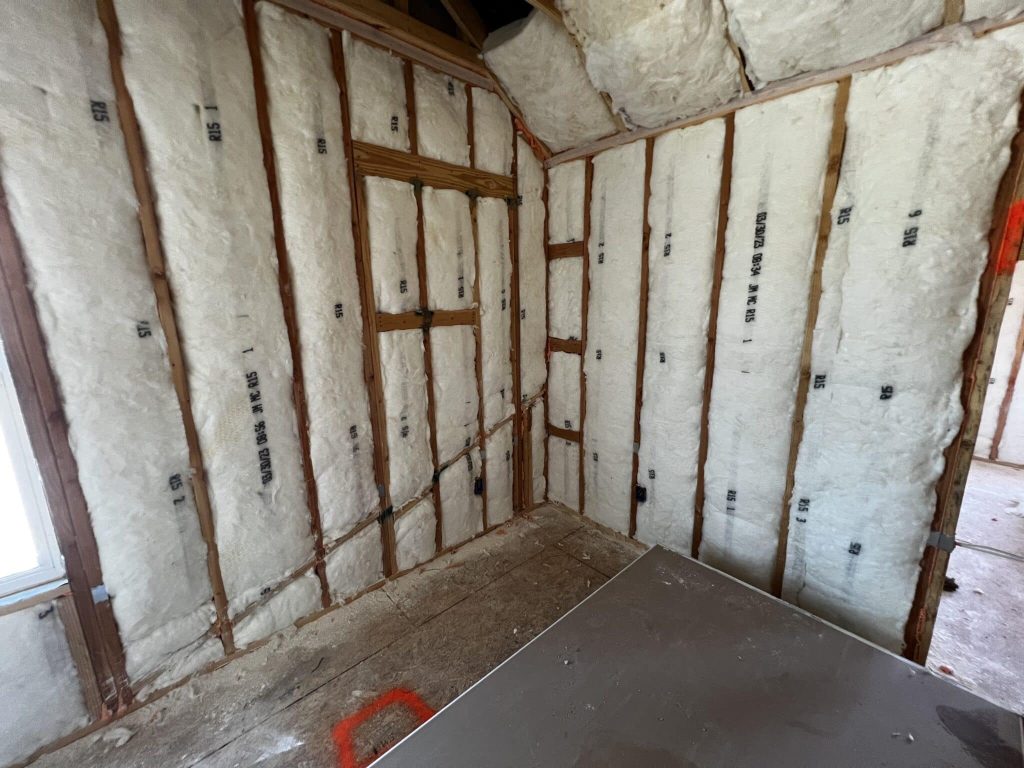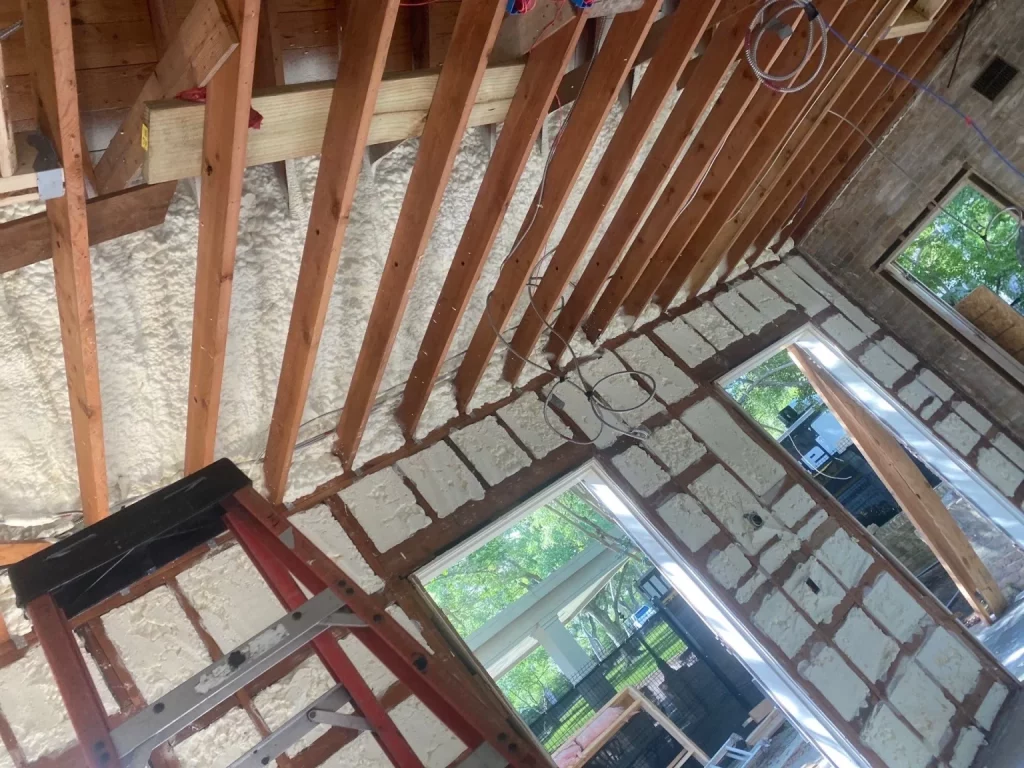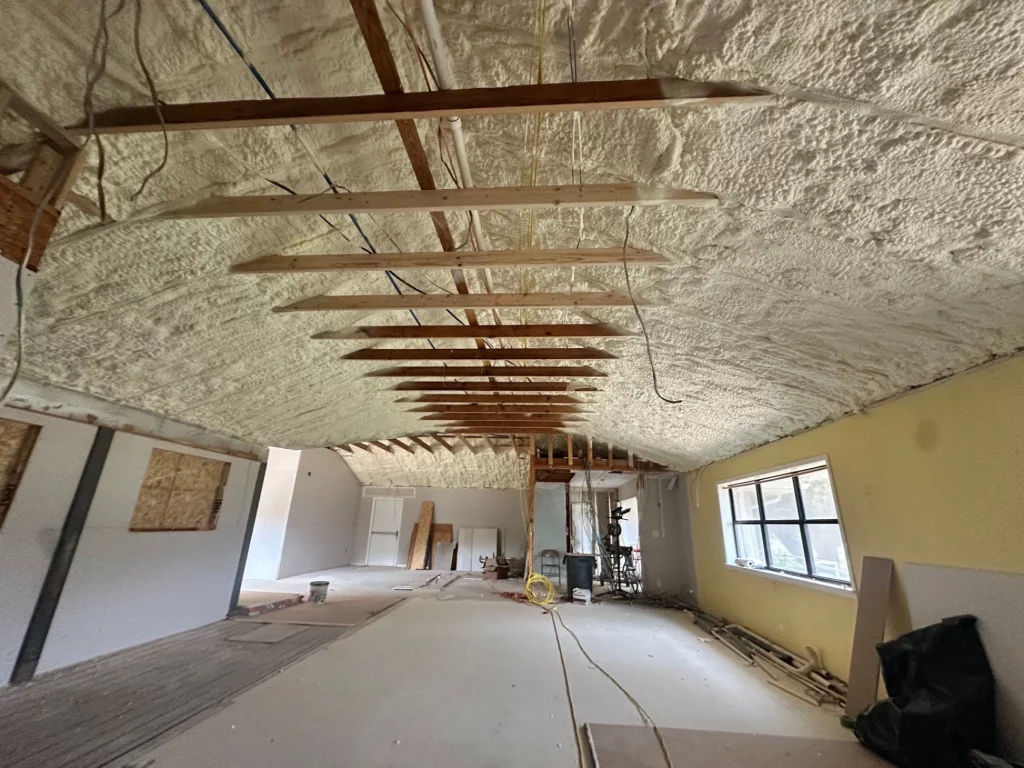
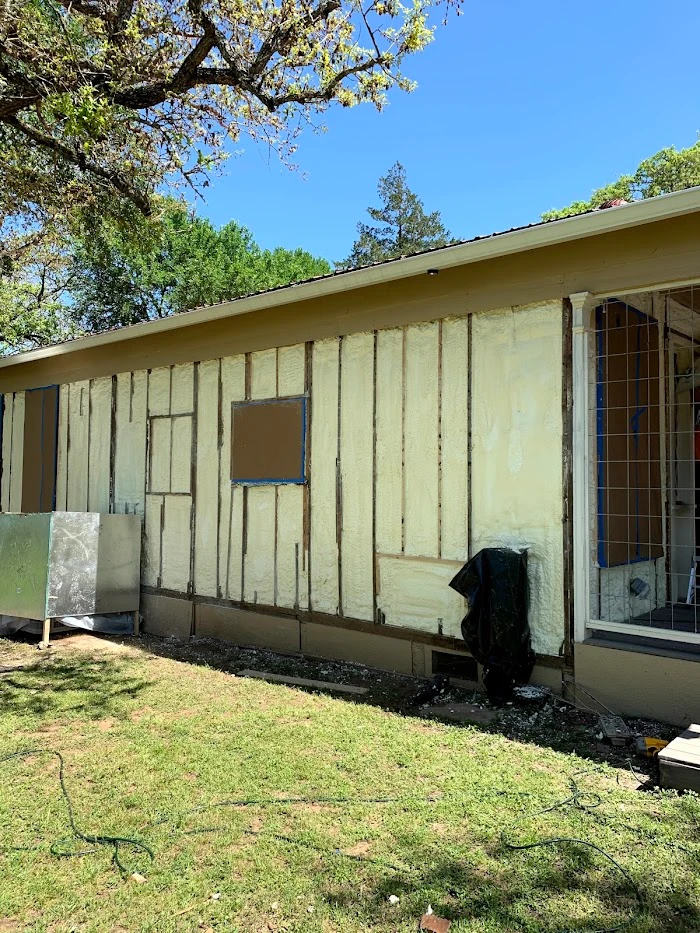
Both closed-cell and open-cell spray foam are combustible materials that require thermal barriers in occupied spaces. Neither type is fireproof. However, closed-cell spray foam typically achieves a fire rating with a Flame Spread Index (FSI) of 15-25, while open-cell foam generally ranges from FSI 20-35 and may fall depending on the formulation. When properly covered by a code-approved thermal barrier such as 1/2-inch gypsum drywall, both types meet building code requirements and perform safely in residential and commercial construction.
The key distinction is that closed-cell foam’s denser, more rigid structure provides better inherent fire resistance when tested alone, but both products must be installed with thermal barriers to satisfy International Building Code and International Residential Code requirements. The thermal barrier, not the foam type itself, delivers the primary fire protection in occupied spaces.
TLDR / Key Takeaways
- Both closed-cell and open-cell spray foam are combustible and require separation from occupied spaces via thermal barriers per IBC and IRC codes.
- Closed-cell spray foam achieves Class 1 fire ratings (FSI 15-25) more consistently due to higher density and flame-retardant formulation.
- Open-cell spray foam typically has FSI ratings of 20-35, placing it in Class 1 or Class 2, depending on the manufacturer’s formulation.
- A 15-minute thermal barrier (1/2-inch gypsum drywall or equivalent) is mandatory for both foam types in interior applications.
- Attics and crawl spaces with restricted access may use ignition barriers instead of thermal barriers for both foam types.
- Neither foam type is fireproof, regardless of fire ratings, and both require proper installation and covering.
- Building code compliance depends on the assembly meeting ASTM E84 and ASTM E119 standards, not foam type alone.
How Fire Resistance Is Measured for Spray Foam
Understanding the testing standards helps clarify the fire resistance comparison between foam types. Building codes rely on two primary test methods to classify spray foam fire performance.
ASTM E84: Surface Burning Characteristics
ASTM E84 measures how quickly flames spread across a material surface and how much smoke develops during combustion. The test places a 25-foot sample in a horizontal tunnel furnace and assigns two index numbers.
Flame Spread Index (FSI) ratings classify materials as follows:
- Class 1 (Class A): FSI 0-25
- Class 2 (Class B): FSI 26-75
- Class 3 (Class C): FSI 76-200
Smoke Developed Index (SDI) must remain at 450 or below for all classifications. According to SprayFoam Magazine’s fire code requirements guide, building codes require spray foam insulation in residential interior walls, ceilings, and floors to have a flame spread index of 75 or less and a smoke developed index of 450 or less.
ASTM E119: Fire-Resistance Ratings
ASTM E119 tests entire wall, floor, or ceiling assemblies rather than insulation materials alone. This test determines how long an assembly resists structural failure and flame or heat transmission under standardized fire exposure conditions. Ratings are expressed in hours: 1-hour, 2-hour, 3-hour, or 4-hour fire-resistance.
Per R-Value Associates’ compliance guide, spray foam itself does not have an E119 rating; assemblies do. The gypsum layers provide fire resistance while the foam delivers thermal and air barrier performance.
Direct Comparison: Closed-Cell vs Open-Cell Fire Performance
| Property | Closed-Cell Spray Foam | Open-Cell Spray Foam |
|---|---|---|
| Density | 1.5-3.5 lbs/cu ft | 0.5-1.5 lbs/cu ft |
| Typical FSI (ASTM E84) | 15-25 | 20-35 |
| Fire Rating Class | Class 1 (most products) | Class 1 or Class 2 |
| Smoke Developed Index | 300-450 | 300-450 |
| Cell Structure | Sealed, rigid cells | Open, flexible cells |
| Moisture Resistance | Yes | No |
| Vapor Retarder | Yes | No |
| R-Value per inch | R-6 to R-7 | R-3.5 to R-4 |
| Thermal Barrier Required | Yes | Yes |
| Ignition Barrier in Attics | Yes | Yes |
Closed-cell spray foam‘s higher density creates a more effective barrier against flame penetration. The sealed cell structure limits oxygen access to the foam interior, slowing combustion progression. According to R-Value Associates, most closed-cell polyurethane foams are formulated with flame retardants and can achieve Class 1 ratings (FSI below 25).
Open-cell foam’s lower density means less material mass to resist heat, and the open-cell structure allows more air circulation, potentially supporting flame spread more readily. However, SprayFoam Magazine’s FAQ for Building Code Officials notes that both open and closed cell foams qualify as air-impermeable insulation when properly installed.
What Building Codes Require
The International Building Code (IBC) and International Residential Code (IRC) impose identical fire safety requirements on both spray foam types once installed in occupied spaces. Understanding these requirements eliminates any confusion about fire resistance advantages.
Thermal Barrier Requirements
IBC Section 2603.4 and IRC Section R316.4 require a 15-minute thermal barrier between foam plastic insulation and the interior of any building. The most common approved thermal barrier is 1/2-inch gypsum wallboard. Alternative materials must pass ASTM E119 testing to limit surface temperature rise to 250 degrees Fahrenheit after 15 minutes of fire exposure.
According to SprayFoam Magazine’s comprehensive guide, thermal barriers must be installed over all foam plastics in residential building construction. Code officials may accept the installer’s certificate listing the foam type and manufacturer data sheets demonstrating compliance with surface burning characteristics.
Ignition Barrier Exceptions
Attics and crawl spaces where entry is made only for utility service access qualify for ignition barriers instead of thermal barriers. The IRC lists six permitted ignition barrier materials:
- 1-1/2 inches mineral fiber insulation
- 1/4 inch wood structural panels
- 3/8 inch particleboard
- 1/4 inch hardboard
- 3/8 inch gypsum board
- Corrosion-resistant steel (0.016-inch base metal thickness)
This exception applies equally to closed-cell and open-cell spray foam. Green Building Advisor’s discussion confirms that both foam types require thermal barriers in most interior applications, with ignition barriers permitted only in restricted-access attics and crawl spaces.
Code Compliance Documentation
Contractors must provide documentation demonstrating code compliance upon request from building officials. Required documentation includes:
- ASTM E84 test reports showing FSI and SDI ratings
- Manufacturer technical data sheets
- ICC-ES Evaluation Reports (ESR) when available
- Installation certificates confirming proper application
The Spray Polyurethane Foam Alliance provides SPFA-148, a sample Insulation Installation Certificate form for compliance with building code requirements for insulation levels and fire safety.
Real-World Application Scenarios
| Scenario | Property Type | Recommended Option | Fire Safety Consideration |
|---|---|---|---|
| Basement walls with finished living space above | Residential | Closed-cell | Higher R-value in limited thickness; Class 1 rating; thermal barrier required |
| Attic with storage flooring | Residential | Either (with ignition barrier) | Closed-cell preferred for moisture resistance in vented attics |
| Crawl space encapsulation | Residential | Closed-cell | Moisture barrier properties: reduces moisture issues beneath the structure |
| Unvented attic above habitable rooms | Residential | Either | Both provide air sealing; closed-cell preferred in mixed climates |
| Commercial interior walls requiring 2-hour rating | Commercial | Closed-cell | More readily included in tested UL assemblies |
| Below-grade exterior foundation | Residential/Commercial | Closed-cell | Exterior application requires moisture resistance and structural support |
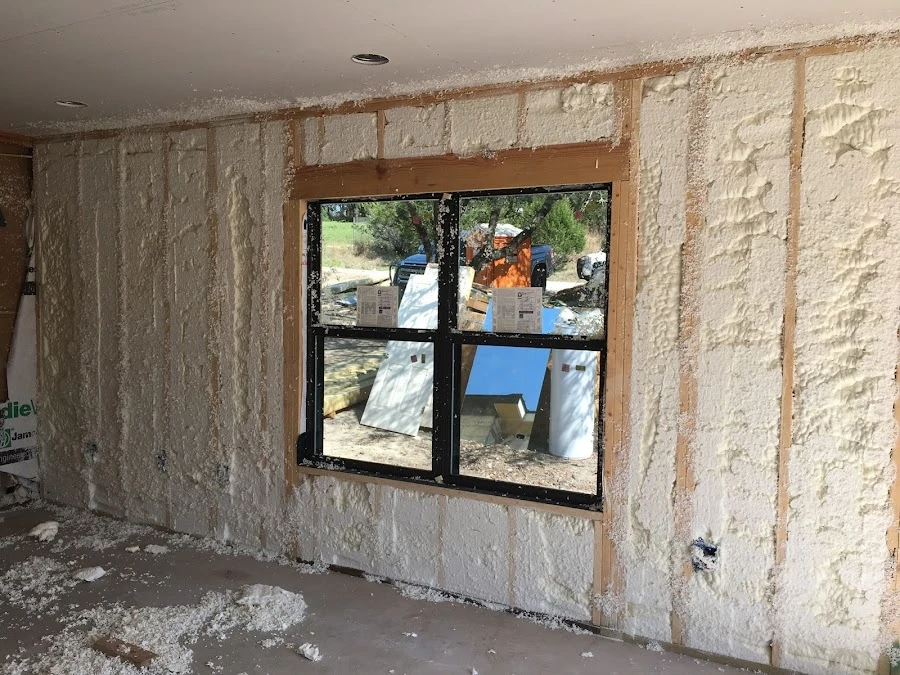
Factors That Influence the Decision
Climate Zone
In cold climates, closed-cell foam’s higher R-value per inch allows achievement of target insulation levels in cavity-limited applications such as 2×4 walls. The moisture resistance also prevents condensation issues in climate zones 4 and above. Open-cell foam remains a viable option in wall cavities where depth is not constrained, and moisture is not a concern.
Moisture Exposure
Closed-cell foam’s resistance to moisture penetration makes it the preferred choice for basements, crawl spaces, and below-grade applications where water exposure is possible. Open-cell foam can absorb and retain moisture, potentially causing degradation and mold issues over time.
Structural Requirements
Closed-cell foam adds structural rigidity to wall assemblies due to its density and bond strength. This characteristic benefits applications where racking resistance or shear wall values are considerations. Open-cell foam provides minimal structural contribution.
Budget Constraints
Open-cell foam typically costs less per board foot than closed-cell foam. For projects where fire resistance is the primary concern and budget is limited, open-cell foam with proper thermal barrier installation delivers code-compliant performance.
Application Area
Certain applications favor one foam type over the other:
- Rim joists: Closed-cell preferred (air sealing and moisture resistance)
- Interior wall cavities: Either option with a thermal barrier
- Cathedral ceilings: Closed-cell preferred (thinner application for equivalent R-value)
- Sound-dampening applications: Open-cell preferred (better acoustic properties)
Thickness Limitations
When installation depth is limited, closed-cell foam’s higher R-value per inch becomes advantageous. A 2×4 wall cavity filled with closed-cell foam achieves approximately R-24, while open-cell foam in the same cavity reaches approximately R-15.
Who This Is For
Choose Closed-Cell Spray Foam When:
- Working in climate zones 4 through 8, where moisture resistance matters
- Insulating basements, crawl spaces, or below-grade areas
- Dealing with a limited cavity depth requiring a high R-value per inch
- Project specifications call for vapor retarder properties
- Structural reinforcement is needed for wall assemblies
- Installing in areas with potential water exposure
Choose Open-Cell Spray Foam When:
- Budget constraints are the primary project driver
- Interior wall cavities offer sufficient depth for target R-values
- Sound absorption is a priority (home theaters, recording studios)
- Working in climate zones 1-3 with limited moisture concerns
- Attic spaces require fill without adding significant weight to the structure
- Retrofitting existing buildings where cavity depth is adequate
The Bottom Line on Fire Resistance
Neither closed-cell nor open-cell spray foam is fireproof. Both products are combustible plastics that require thermal barriers for code compliance in occupied spaces. The notion that one foam type eliminates the need for thermal barriers is incorrect and contradicts building code requirements.
Closed-cell foam provides slightly better inherent fire resistance due to higher density, slower charring rate, and more consistent Class 1 (Class A) ratings under ASTM E84 testing. Open-cell foam performs adequately when properly formulated with flame retardants and covered by the required thermal barriers.
The American Chemistry Council’s Center for the Polyurethanes Industry guidance states clearly that spray foam should be considered combustible and handled accordingly, regardless of type.
For contractors and building owners, the fire resistance decision should focus on:
- Specifying products with documented Class 1 fire ratings
- Ensuring proper thermal barrier installation
- Verifying code compliance documentation is available on-site
- Following the manufacturer’s installation guidelines precisely
Ready to Specify the Right Spray Foam?
Our team at Stellrr Insulation & Spray Foam brings decades of combined experience in spray foam applications across residential and commercial projects. We help contractors and building owners select the appropriate foam type based on fire safety requirements, climate considerations, and budget constraints.
Whether your project requires closed-cell foam for a basement encapsulation or open-cell for interior wall insulation in a climate-appropriate application, our certified installers ensure code-compliant fire barrier installation on every job.
Contact us today to discuss your project requirements or request a consultation for your next insulation specification.
- Phone: 512-520-0044
- Email: info@stellrr.com
Don’t leave fire safety compliance to chance. Our team reviews every project against current IBC and IRC requirements and provides documentation packages that streamline building official approvals.
Frequently Asked Questions
Can spray foam insulation be left exposed without a thermal barrier?
No. Both closed-cell and open-cell spray foam require a 15-minute thermal barrier (typically 1/2-inch gypsum drywall) separating the foam from occupied spaces. Exceptions exist only for attics and crawl spaces with restricted access, where ignition barriers may be used instead.
Does closed-cell spray foam catch fire more easily than open-cell?
No. Closed-cell foam typically has lower flame spread indices (15-25) compared to open-cell foam (20-35) under ASTM E84 testing. Both types contain flame retardants and neither is fireproof. All spray foam is combustible and requires thermal barriers for code compliance.
What happens if spray foam is installed without the required thermal barrier?
Installing spray foam without a required thermal barrier violates IBC and IRC code requirements. Building officials may issue stop-work orders, require removal and reinstallation with proper barriers, or fail the inspection. Building owners face increased liability exposure if fires occur in structures without required fire protection.
Do both foam types need the same thickness of thermal barrier?
Yes. Building codes require 1/2-inch gypsum wallboard (or equivalent tested material) as the thermal barrier regardless of which spray foam type is installed. The barrier requirement does not vary based on foam type or fire rating classification.
Are there spray foam products that eliminate the need for thermal barriers?
Some intumescent coatings have been tested as alternatives to prescriptive thermal barriers, but these coatings still must be applied to the foam surface. No spray foam product can be legally left exposed in occupied spaces without either a thermal barrier or an approved alternative assembly tested specifically for that application.
Sources
- SprayFoam Magazine – Fire Code Requirements for SPF Applications – Comprehensive guide to International Building Code and International Residential Code requirements for spray polyurethane foam fire testing, thermal barriers, and ignition barriers in residential and commercial applications.
- R-Value Associates – Spray Foam Fire Ratings: ASTM E84 & E119 Compliance Guide – Technical explanation of ASTM E84 surface burning characteristics, ASTM E119 fire-resistance ratings, and UL assembly listings required for code-compliant spray foam installation in commercial construction.
- SprayFoam Magazine – FAQ for Building Code Officials – Answers to common questions about thermal barriers, ignition barriers, and code compliance for spray foam insulation installation including distinctions between attic and crawl space requirements.
- Green Building Advisor – Is Closed-Cell Spray Foam Fire Resistant? – Community discussion addressing common misconceptions about closed-cell spray foam fire resistance and thermal barrier requirements from building science professionals.
- Spray Polyurethane Foam Alliance – Technical Documents – Industry resource library including SPFA-126 on thermal and ignition barrier requirements, SPFA-148 sample installation certificates, and guidance documents for code compliance documentation.